

Butterfly Chair Mechanism
Dual-wing folding butterfly chair mechanism — engineered for compact shipping and high-cycle hospitality use.
Cold-rolled steel construction, 60,000-cycle tested, folds flat for container-efficient shipping. OEM/ODM tooling supported.

Product Overview
What the Butterfly Chair Mechanism Is — and Where It Fits Your Line
The butterfly chair mechanism is a dual-wing folding bracket assembly that allows a chair's seat and frame to collapse inward symmetrically — the two "wings" fold toward each other, bringing the chair to a flat or near-flat profile. The name comes from the wing geometry: when open, the bracket arms spread outward like a butterfly; when folded, they close flat against the seat frame.
This is not a general-purpose folding mechanism. The butterfly design is specific to chairs where the folded profile matters commercially — event seating, hospitality stacking chairs, rental fleet furniture, and any application where you're shipping, storing, or transporting chairs in volume.
The Fold Ratio Is the Value
A butterfly mechanism typically reduces the chair's stacked depth by 60–70% compared to a rigid frame. This translates directly into container loading efficiency and warehouse storage density — the commercial case for specifying this mechanism over a fixed-frame design.
If you're sourcing for a chair line that ships flat-packed or stacks for storage, the butterfly mechanism is the hardware that makes that possible. If your chair is a fixed-frame design, this isn't the right product — the tilt chair mechanism or folding chair mechanism lines are more appropriate.

Event Seating
High-volume stacking and transport for banquet and conference applications.
Hospitality
Stacking chairs for hotels, venues, and food service environments.
Rental Fleet
Furniture rental operations where compact storage and transport density matter.
Flat-Pack Shipping
Container-efficient export lines where folded profile drives landed cost.
Engineering Data
Technical Specifications
Industry-standard parameters for butterfly chair mechanisms of this type. Actual specifications vary by configuration — contact us for exact product data sheets and drawings.
Specifications shown are industry-standard values for this product type. Contact us for detailed product data sheets with exact dimensions and tolerances.
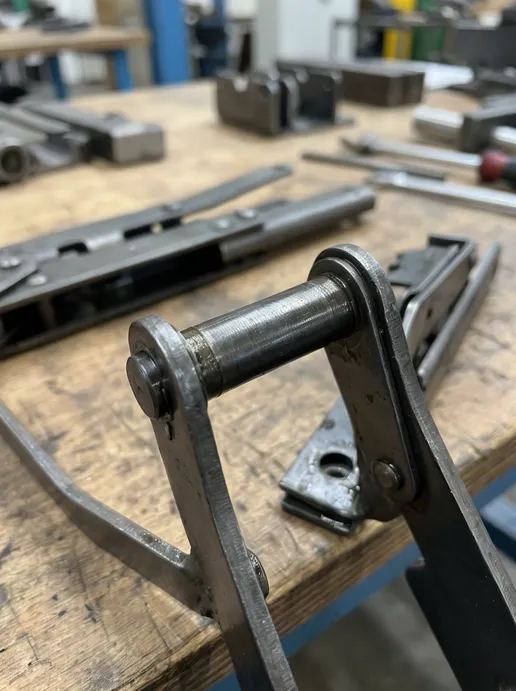
Pivot Pin: The Structural Critical Point
The pivot pin carries the full dynamic load every time the chair is opened or closed. We run the pivot at 8–10 mm diameter in hardened steel — the spec that holds up under the open-close frequency of event and rental use.
Undersized pivots are the leading failure mode we see in lower-cost butterfly mechanisms that come through our lab for comparison testing.
How We Make the Butterfly Mechanism — Process Details That Affect Your Order
Wing Arm Stamping
Wing arms are stamped from cold-rolled steel coil on progressive dies. The complete arm geometry — mounting holes, pivot bore, fold-stop notch — comes out of a single press stroke, so every arm in a production run is dimensionally identical. We hold ±0.15 mm on the pivot bore, which is the tolerance that determines whether the fold action is smooth or whether there's slop in the hinge that your end users will feel on the first open-close.
Press-Fit Staked Pivot Pins
Pivot pins are press-fit and staked, not threaded. Threaded pivot assemblies are faster to produce but loosen under cyclic load — we switched to press-fit staking on this product after seeing thread-loosening failures in field returns from an early export batch. The press-fit assembly adds a step, but the pivot stays tight through 60,000 cycles.
Welding & Fold-Stop Geometry
Welding on the bracket-to-seat-frame connection points uses MIG with verified penetration depth. The fold-stop geometry is built into the stamped arm profile rather than added as a separate welded stop — fewer weld points means fewer potential failure sites, and the stamped stop is dimensionally consistent across the run.
Surface Treatment
Surface treatment is zinc plating as standard, with powder coating available. We run zinc plating on butterfly mechanisms by default because the dimensional tolerance on the pivot assembly is tight enough that powder coat thickness (60–80 μm) can affect pivot fit on some configurations. If you need powder coat for color matching or corrosion resistance in coastal markets, we adjust the pivot bore spec to compensate.
Supplier note: We've seen powder-coated butterfly mechanisms from other suppliers where the pivot binds because nobody accounted for coating buildup in the bore. Our bore spec adjustment is a standard step in our powder coat process — not an afterthought.

Market Segments Where Butterfly Mechanisms Drive Volume
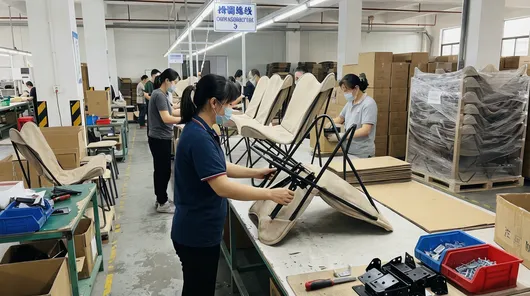
Hospitality & Event Seating
Hotels, conference centers, banquet halls, and event rental companies are the core buyers for butterfly chair mechanisms. These operations run fleets of 500 to 5,000+ chairs that get set up, broken down, and stored repeatedly. Compact fold ratio determines how many chairs fit in a storage room or on a transport truck — that's a direct operating cost for the venue or rental company.
Container-load orders are standard in this segment. A 40HQ container of folded butterfly-mechanism chairs typically holds 30–40% more units than the same chair in a rigid-frame configuration, which reduces your per-unit landed cost and your buyer's per-unit storage cost.
Reorder pattern: Fleet replacement typically runs every 3–5 years as chairs accumulate damage from handling. Event rental companies are among our most consistent repeat buyers — the reorder pattern is reliable once the initial relationship is established.
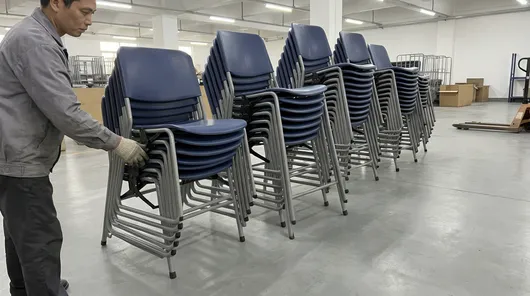
Institutional Stacking Chairs
Schools, universities, community centers, and government facilities buy stacking chairs on annual procurement budgets. The butterfly mechanism serves the segment where chairs need to fold flat for storage in multi-use spaces — gymnasiums, auditoriums, meeting rooms that convert between configurations.
Order sizes typically run 200–1,000 units per institution, with repeat orders tied to facility expansion or replacement cycles.
Durability note: Institutional chairs get heavy use but less frequent fold-unfold cycling than event rental. The 60,000-cycle spec is more than sufficient; the structural load rating matters more because institutional users are less careful with equipment than trained event staff.
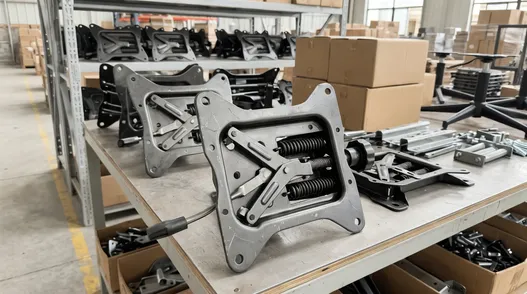
Export Distribution & Furniture Wholesalers
If you're a furniture hardware distributor or a wholesaler supplying chair manufacturers, the butterfly mechanism is a SKU that serves a specific, identifiable demand segment. It's not a commodity item — buyers who need it know they need it, and they're looking for a supplier who stocks it reliably.
Carrying butterfly mechanisms alongside folding chair mechanisms and standard tilt mechanisms lets you serve the full range of folding and stacking chair manufacturers from a single supplier relationship.
OEM & Private Label
Customization Options
Standard butterfly chair mechanisms ship at 500-unit MOQ. The following customization dimensions are available within that baseline — or with OEM tooling for geometry changes.
| Customization | Options | MOQ Impact |
|---|---|---|
| Wing arm dimensions | Modified length/width within tooling range | Standard MOQ |
| Mounting hole pattern | Custom 4-hole or 6-hole patterns | Standard MOQ |
| Pivot pin diameter | 8 mm or 10 mm standard; other diameters on request | Standard MOQ |
| Surface treatment | Zinc plating (standard), powder coating, nickel plating | Standard MOQ |
| Powder coat color | Any RAL color | 500 units / color |
| Fold angle / stop position | Modified stop geometry | OEM tooling required |
| Private label / branding | Stamped or laser-marked part numbers | Standard MOQ |
| Custom arm geometry | Full OEM tooling development | Discuss during quoting |
Within Existing Tooling
For modifications within existing tooling range, first samples are typically produced in 15–20 days. No new die work required — arm dimensions, hole patterns, pin diameters, surface treatments, and private labeling all fall within this path.
Full OEM Tooling
Custom arm geometry or non-standard fold geometry requires new die work. Tooling is cut in-house: 25–35 days from drawing approval to first sample — the same timeline as other mechanism OEM projects.
Designing a new chair model?
If you need a butterfly mechanism with non-standard fold geometry or a specific folded-profile dimension, send us your chair frame drawings. Our engineering team will assess whether the modification fits within existing tooling or requires new die work, and quote accordingly.
Logistics & Freight
Packaging, Container Loading & Landed Cost
The butterfly mechanism's folding profile directly affects your container economics. Here's what to know before you finalize order quantities.

Carton & Pallet Configuration
Mechanisms ship in bulk cartons — typically 20–50 units per carton depending on arm size — with foam or paper interleaving to prevent surface damage in transit. Cartons are palletized for container loading.
Because the mechanism ships in the folded position, carton dimensions are significantly smaller than for rigid mechanism assemblies of equivalent load rating. This directly improves your container utilization.
Why Container Loading Matters at This Price Point
The per-unit freight cost difference between filling a container and shipping a partial load is meaningful. We can provide exact container loading calculations during quoting — this is worth running before you finalize your order quantity.
Shipping as Complete Folded Assembly
For buyers supplying chair manufacturers who assemble in-country, the mechanism ships as a complete folded assembly ready for installation.
For buyers shipping complete chairs in folded configuration, the mechanism's fold ratio is the key spec — confirm the folded chair dimensions against your target container loading plan before finalizing the chair frame design.
White-Label Packaging
White-label packaging and private-label part marking are available at standard MOQ. If you're supplying under your own brand, we pack and mark to your specification.
Landed Cost Calculation
We provide exact container loading calculations during quoting. Request this before finalizing your order quantity — the freight math at partial vs. full container load is a real cost variable worth optimizing.
Get Container Loading Calculations with Your Quote
Tell us your target order quantity and arm size. We'll include exact carton dimensions, units per container, and pallet configuration in the quote — so you can optimize order size against freight cost before committing.
Standards & Documentation
Compliance & Certification
CE marking, SGS testing, and RoHS compliance documentation ship with every order. Our quality management system is ISO 9001:2015 certified. Third-party testing for additional market standards can be arranged through our SGS relationship — specify your target market during quoting.
CE Marking
Standard on all butterfly chair mechanisms. Covers EU market entry requirements.
SGS Tested
Mechanism tested by SGS. Test reports available on request for buyer verification.
RoHS Compliant
Material composition within RoHS limits for restricted substances. Documentation ships with every order.
ISO 9001:2015
Quality management system certified. Cycle life testing follows BIFMA X5.1 equivalent protocols — 60,000 cycles at rated load.
Cycle Life Testing Protocol
60,000 cycles at rated load, with load applied at the seat mounting points to simulate real use conditions. Test reports are available on request.
Additional Market Standards
For buyers supplying into markets with specific furniture safety standards, we can arrange third-party testing through our SGS relationship. Specify your target market's standard during quoting.
Buyer Questions
Frequently Asked Questions
Technical and commercial questions answered for buyers specifying butterfly chair mechanisms for production.
What is a butterfly chair mechanism and how does it differ from a standard folding chair mechanism?
A butterfly mechanism uses two symmetrical wing arms that fold inward toward each other, collapsing the chair frame from both sides simultaneously. A standard folding chair mechanism typically folds along a single axis — the seat folds up against the backrest, or the legs fold under the seat. The butterfly design produces a flatter, more compact folded profile than single-axis folding, which is why it's specified for high-density storage and shipping applications. The trade-off is slightly higher mechanism complexity and cost versus a simple fold-flat bracket.
What load capacity should I specify for event and hospitality use?
For standard adult seating in event and hospitality applications, a 120 kg static load rating is the minimum. If your chairs will be used in environments where users may stand on them or where abuse loading is likely (outdoor events, school use), specify 150 kg.
How does powder coating affect the butterfly mechanism's fold action?
Powder coat adds 60–80 μm of thickness to all surfaces, including the pivot bore. On a tight-tolerance pivot assembly, that buildup can cause the fold action to bind if the bore isn't adjusted to compensate.
We account for this in our production spec — when you order powder-coated butterfly mechanisms, we run the pivot bore at a slightly larger diameter to maintain the correct clearance after coating. Specify your surface treatment requirement upfront so we can set the correct bore spec from the start.
What is the MOQ for butterfly chair mechanisms, and can I mix with other mechanism types?
Standard MOQ is 500 units for butterfly chair mechanisms. You can combine butterfly mechanisms with other mechanism types (folding, tilt, swivel) in a single order — each type runs on its own production line, so mixing doesn't extend lead time.
For new buyers, we recommend a 2–5 unit sample order first to verify fit with your chair frame before committing to production quantities.
Can the fold stop angle be customized?
Yes, but it requires tooling modification. The fold stop is built into the stamped arm geometry, so changing the stop angle means modifying the die. For orders with sufficient volume to justify the tooling investment, we can develop a custom stop angle. Send us your target folded and open angles and we'll assess the tooling scope and cost.
What certifications does the butterfly chair mechanism carry?
CE marking, SGS testing, and RoHS compliance documentation are standard. ISO 9001:2015 governs our quality management system. If your market requires additional certification (BIFMA, EN 1022, or others), contact us during quoting — we can arrange third-party testing through our SGS relationship.
Explore More
Related Chair Mechanisms
If the butterfly mechanism isn't the right fit for your application, these are the most relevant alternatives in our line.
Folding Chair Mechanism
Single-axis fold-flat bracket for stackable seating. Lower mechanism cost than butterfly, suitable when the dual-wing fold profile isn't required. Our highest-volume export item in the folding category.
Simple Chair Mechanism
Fixed or minimal-adjustment mechanism for budget seating lines where folding isn't needed. Lowest unit cost in the chair mechanism range.
Metal Chair Mechanism
All-metal heavy-duty construction for industrial or outdoor seating where maximum durability is the priority over fold functionality.
Request a Quote
Get a Quote for Butterfly Chair Mechanisms
Most new buyers start with a sample order — 2–5 units to test fit and fold action against your chair frame before committing to production quantities. We can ship samples within 7–10 days of order confirmation.
If you're ready to quote production quantities, send us your target spec: arm dimensions, mounting pattern, surface treatment, and annual volume. If you have a chair frame drawing, include it — our engineering team will confirm fit and flag any configuration adjustments before production starts.
What to Include in Your Quote Request
-
Arm dimensions and mounting pattern
-
Surface treatment preference (powder coat, chrome, raw steel)
-
Target annual volume
-
Chair frame drawing (if available — engineering team will confirm fit)