Most pricing surprises don't happen at the factory gate. They happen three months later, when a batch fails load testing, or when your customer's warranty claims start stacking up, or when you realize the "cheap" mechanism you sourced added $4 per unit in rework at your assembly facility. Understanding what actually drives chair mechanism cost puts you in a position to evaluate quotes accurately — not just sort them by price.
This breakdown covers the real cost levers: materials, tolerances, surface treatment, certification overhead, and MOQ structure. Each one affects your landed cost differently, and conflating them is how buyers end up with mechanisms that look identical on paper but perform very differently in the field.

Raw Material: Where the Price Gap Between Suppliers Actually Starts
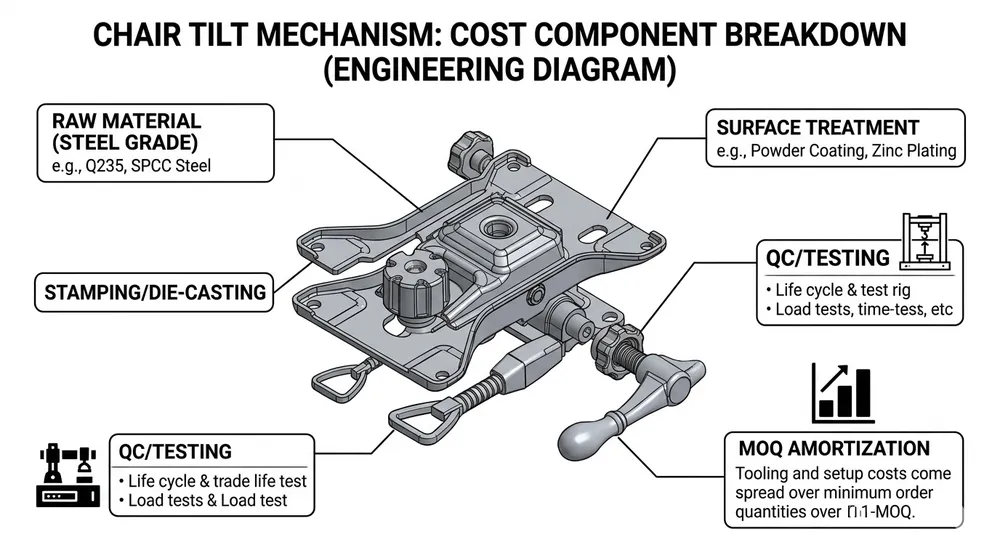
Steel is the dominant input cost for most chair mechanisms — tilt plates, base brackets, and housing components are typically stamped from cold-rolled steel, while load-bearing pivot pins and adjustment knobs often use zinc alloy die-casting. The grade and thickness of that steel is where supplier quotes start diverging.
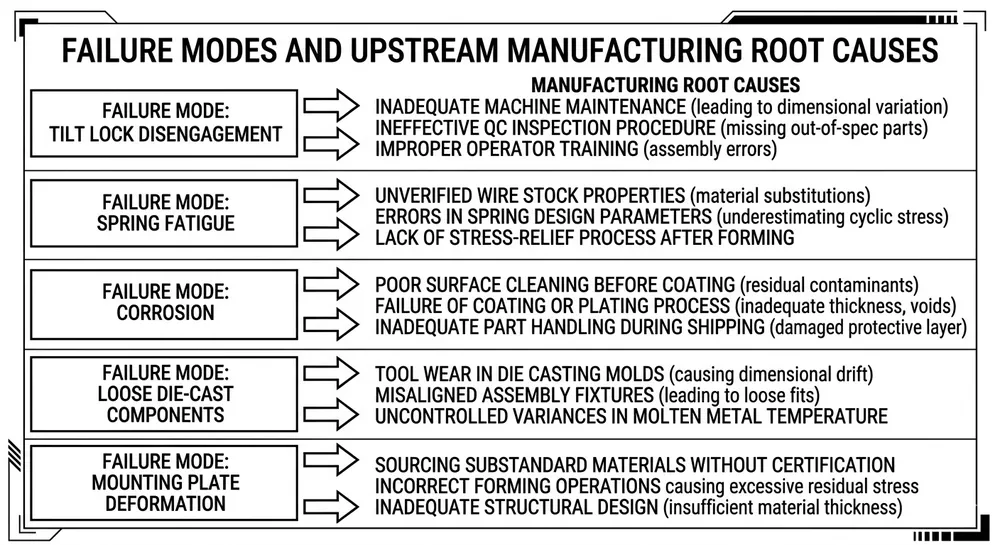
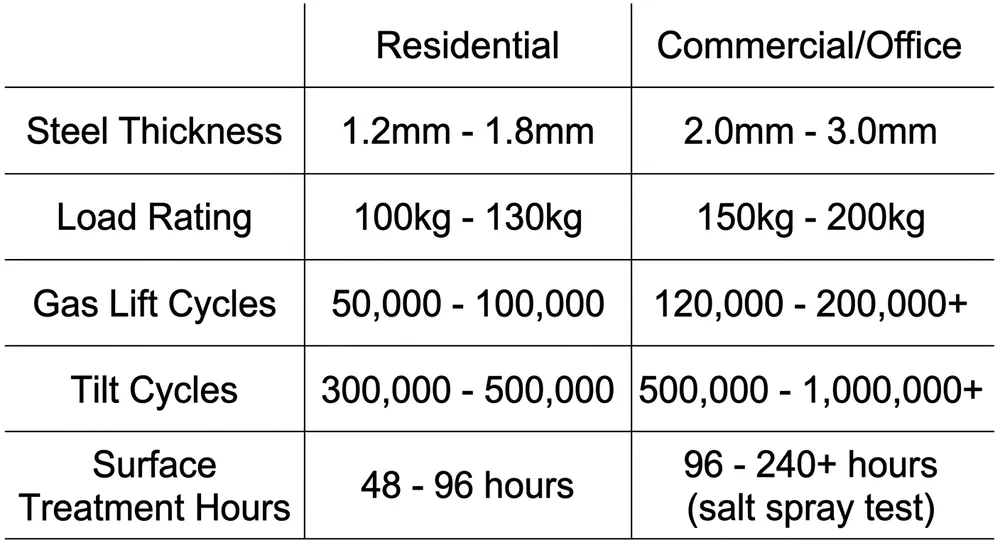
A standard tilt mechanism plate runs 2.0–2.5mm SPCC cold-rolled steel. Some suppliers drop to 1.6mm to shave cost — the part looks identical, passes a visual inspection, and fails a 100,000-cycle load test. We run our tilt plates at 2.0mm minimum and specify the steel from approved mills with consistent yield strength. That's not a premium spec; it's the floor for mechanisms that won't generate warranty claims after 18 months of office use.
Zinc alloy die-casting for pivot components is another split point. Zamak 3 and Zamak 5 are both common, but Zamak 5 has higher tensile strength and better resistance to creep under sustained load — relevant for mechanisms that stay under tension for hours at a time. The cost difference per unit is small. The performance difference over a 5-year product life is not.
| Component | Typical Material | Cost Sensitivity |
|---|---|---|
| Tilt plate / base bracket | 2.0–2.5mm SPCC cold-rolled steel | High — gauge and grade directly affect cycle life |
| Pivot pins / knobs | Zinc alloy die-cast (Zamak 3 or 5) | Medium — alloy grade affects long-term load performance |
| Springs | Carbon spring steel | Medium — wire diameter and temper affect tension consistency |
| Fasteners | Grade 8.8 steel, zinc-plated | Low — but substitution is a common cost-cutting point |
(We've seen fastener substitution — swapping Grade 8.8 for Grade 4.8 — more than once in third-party audits. It's invisible until a mechanism loosens under repeated use.)
Stamping Complexity and Die Investment: The Cost You Pay Once or Every Order
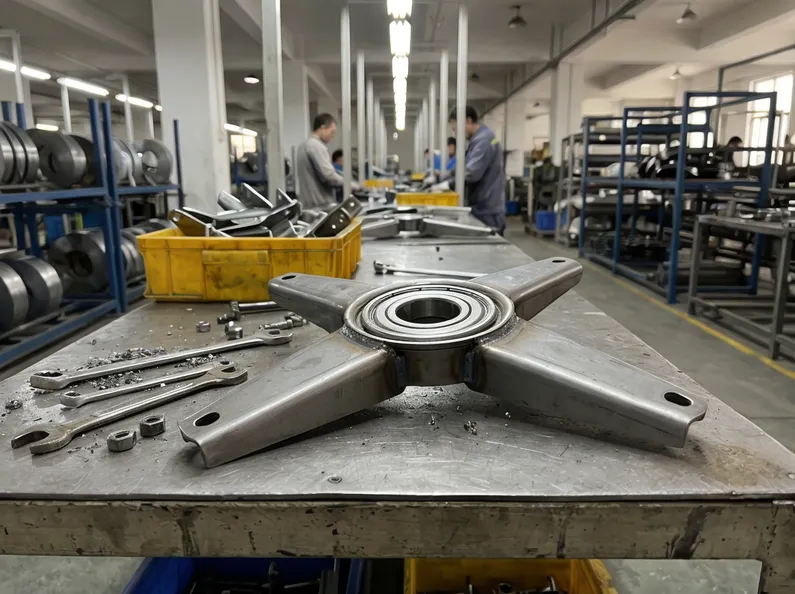
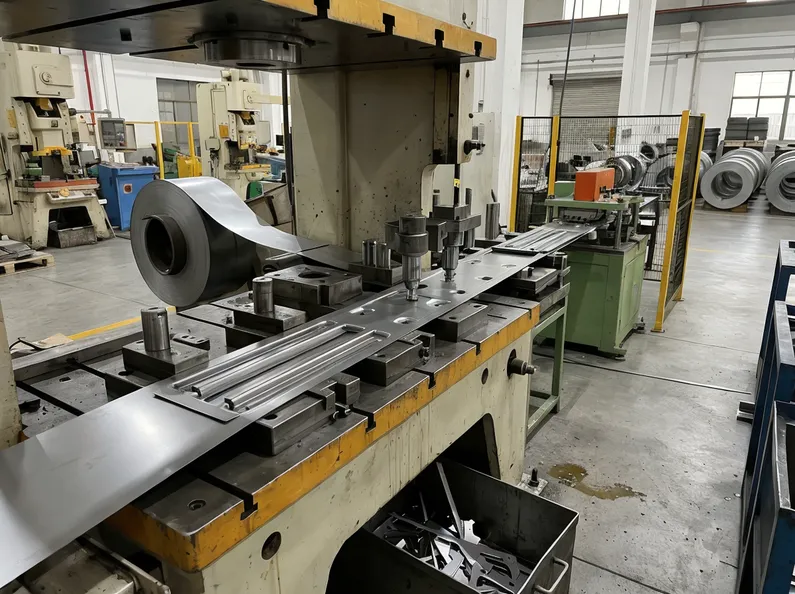
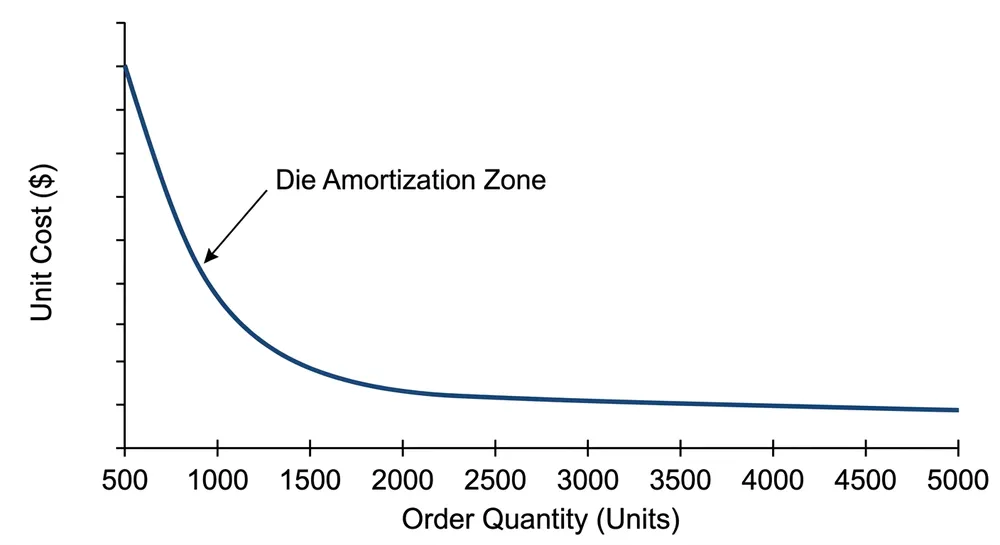
Progressive die stamping is the standard process for chair mechanism plates and brackets. The die itself is a significant upfront investment — a multi-stage progressive die for a tilt mechanism housing runs $8,000–$18,000 depending on complexity and tolerance requirements. That cost gets amortized across production volume, which is why MOQ and unit price are inseparable in this category.
A supplier quoting you $4.20/unit on a 500-unit order and $3.10/unit on a 3,000-unit order isn't padding margin on the small order — they're recovering die amortization faster on the large one. When you're comparing quotes, ask whether the tooling cost is included, amortized, or charged separately. The answer changes the real cost picture significantly.
Tolerance requirements add another layer. A tilt mechanism with a ±0.3mm tolerance on the pivot bore is straightforward to stamp. Tighten that to ±0.1mm and you're adding secondary machining or tighter die maintenance cycles — both of which show up in unit cost. For most commercial office chair applications, ±0.2–0.3mm on critical dimensions is sufficient. Specifying tighter than necessary doesn't improve the product; it just increases your cost.
Surface Treatment: The Spec That Determines Your Warranty Exposure
Surface treatment is where a lot of importers underspecify — and pay for it later. The three standard options for chair mechanisms are zinc plating, nickel plating, and powder coating, and they're not interchangeable from a corrosion resistance standpoint.
Zinc plating (typically 8–12μm) is the baseline. It passes a 72-hour neutral salt spray test and is adequate for dry indoor environments. Nickel plating adds a harder, more wear-resistant surface — relevant for pivot points and adjustment mechanisms that see repeated contact. Powder coating on external-facing components gives you color options and better scratch resistance, but it's not a corrosion treatment on its own; the substrate still needs pre-treatment.
For mechanisms going into markets with humidity exposure — Southeast Asia, coastal US, Middle East — we recommend specifying a minimum 96-hour salt spray requirement and confirming the pre-treatment process (phosphate or chromate conversion coating before plating). A supplier who can't tell you their pre-treatment process is a supplier whose salt spray results you can't trust.
| Surface Treatment | Typical Thickness | Salt Spray Resistance | Best For |
|---|---|---|---|
| Zinc plating | 8–12μm | 72–96 hours | Standard indoor, dry environments |
| Nickel plating | 8–15μm | 120–200 hours | High-wear contact points, humid markets |
| Powder coating | 60–80μm | 500+ hours (with pre-treatment) | External visible components, color matching |
| Zinc + clear passivation | 8–12μm + passivation | 96–120 hours | Cost-effective upgrade for humid markets |
The cost difference between zinc plating and nickel plating on a full mechanism is typically $0.30–$0.80/unit. Against the cost of a warranty return or a market recall, that's not a meaningful number.
Certification Overhead: What CE and SGS Actually Cost in the Price
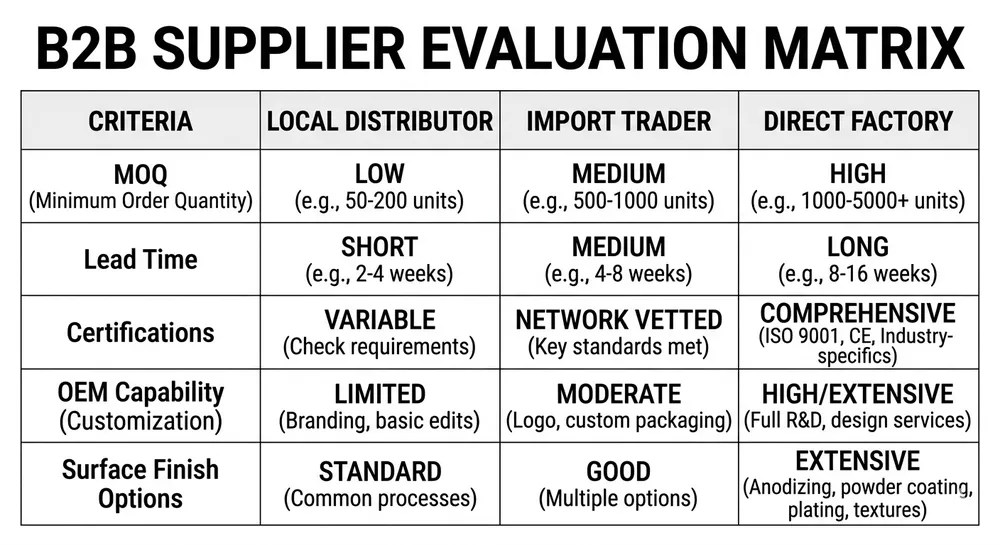
Certifications aren't free, and they're not evenly distributed across suppliers. A factory carrying ISO 9001:2015, CE, and SGS audit coverage has ongoing compliance costs — third-party audits, documentation systems, test lab fees — that get built into unit pricing. A factory without those certifications quotes lower because those costs don't exist in their structure.
For importers selling into Europe, CE marking on chair mechanisms isn't optional — EN 1335 (office chairs) and related standards require documented load testing and cycle life verification. For North American markets, BIFMA compliance is the relevant benchmark. Asking a supplier for their test reports at RFQ stage tells you immediately whether those certifications are real or decorative.
We carry ISO 9001:2015, CE, and SGS certification, with SGS audit reports available on request. Every mechanism batch goes through 100% functional testing and load-cycle verification before shipment — not sampling, 100%. That overhead is in our pricing. It's also why our defect rate on arrival is consistently below 0.3%.
(One thing worth knowing: CE self-declaration is technically permitted for some mechanism categories, but a third-party test report from SGS or TÜV carries significantly more weight with European retail buyers and reduces your own liability exposure.)
MOQ Structure and How It Affects Your Real Unit Economics
The MOQ conversation is usually framed as a minimum order requirement. It's more useful to think of it as a cost structure question: what volume do you need to reach the unit economics that make the product viable in your market?
Our standard MOQ is 500 units for catalog mechanisms. At that volume, you're covering die amortization on existing tooling and running a full production batch through QC. For OEM or ODM work — custom geometry, proprietary spring tension, branded packaging — tooling investment changes the math, and MOQ typically starts at 1,000–2,000 units depending on complexity.
The practical implication for importers: if you're entering a new mechanism category, a 500-unit trial order gives you real market data without overcommitting inventory. Most of our buyers in new categories start there, validate sell-through, then move to 2,000–5,000 unit reorders where the unit economics improve meaningfully.
| Order Volume | Typical Unit Price Impact | Notes |
|---|---|---|
| 500 units | Base price | Die amortization at highest per-unit rate |
| 1,000–2,000 units | 8–15% lower than base | Sweet spot for new SKU validation |
| 3,000–5,000 units | 15–25% lower than base | Full production efficiency, best landed cost |
| 5,000+ units | Negotiable | Volume pricing, dedicated line scheduling available |
What "Cheap" Actually Costs: The Landed Cost Calculation
A $0.80/unit price difference between two mechanism quotes looks significant on a 2,000-unit order — that's $1,600. But run the full landed cost calculation before deciding it's savings.
Factors that erode apparent savings from lower-priced mechanisms:
- Incoming inspection cost: If you can't trust the supplier's QC, you're paying for your own inspection on arrival. At $0.15–0.25/unit for third-party inspection, that's $300–500 on a 2,000-unit order.
- Warranty claim rate: A 2% defect rate on 2,000 units is 40 units. If each warranty claim costs you $15–25 in handling, replacement, and customer service, that's $600–1,000 in downstream cost.
- Rework at assembly: Mechanisms with inconsistent tolerances slow assembly lines. Even 30 seconds of extra adjustment per unit adds up across a production run.
- Market re-entry cost: If a mechanism failure generates a product recall or a major buyer complaint, the cost is not calculable in per-unit terms.
The $0.80 savings disappears quickly. The question isn't which quote is cheaper — it's which quote gives you the lowest total cost of ownership across the product's market life.
Frequently Asked Questions
What is a typical price range for a standard office chair tilt mechanism?
For a standard synchronous tilt mechanism in commercial office chair spec (2.0mm steel plate, zinc plating, 100,000-cycle rated), factory pricing typically runs $4.50–$9.00/unit depending on complexity, order volume, and surface treatment spec. Mechanisms with gas lift integration, multi-function adjustment, or premium surface treatment sit at the higher end. These are FOB Foshan reference ranges — freight, duties, and local handling add to your landed cost.
Does CE certification add significant cost to chair mechanism pricing?
CE compliance adds cost through third-party testing, documentation, and ongoing audit overhead — typically $0.20–$0.50/unit on standard commercial mechanisms when amortized across normal production volumes. For European market entry, that cost is non-negotiable. The more relevant question is whether the supplier's CE documentation is current and backed by actual test reports, not just a self-declaration.
What's the minimum order quantity for custom chair mechanism specifications?
For standard catalog mechanisms, 500 units. For OEM work requiring new tooling (custom geometry, modified spring spec, proprietary adjustment range), tooling investment typically requires 1,000–2,000 units to amortize sensibly. ODM projects with full design development start at higher volumes depending on engineering scope.
How do I verify a supplier's load-cycle test claims?
Ask for the actual test report, not a spec sheet that lists the rating. A credible test report will show the test standard referenced (EN 1335, BIFMA, or equivalent), the test load applied, the number of cycles completed, and the pass/fail criteria. Reports from accredited third-party labs (SGS, TÜV, Intertek) carry more weight than in-house test documentation.
Why do two mechanisms with identical specs quote at very different prices?
The spec sheet rarely captures everything that drives cost: steel mill source and grade consistency, die maintenance frequency, pre-treatment process before surface coating, QC sampling rate vs. 100% testing, and whether certifications are current. Two mechanisms can share the same nominal spec and have very different production quality floors. Requesting a sample order before committing to volume is the most reliable way to verify what you're actually buying.
If you're evaluating mechanism options for a new product line or comparing current supplier pricing, request a quote with your target spec — we'll send back a detailed breakdown with material grade, surface treatment, and test documentation included.