

Chair Mechanism Hinge
Stamped steel chair mechanism hinges — the pivot point that determines whether a folding or reclining chair survives commercial use.
Produced in-house from cold-rolled steel with ±0.15mm dimensional tolerance. 100% functionally tested before shipment. Available as standalone components or integrated into complete mechanism assemblies.

Product Overview
What a Chair Mechanism Hinge Is — and Where It Fails
A chair mechanism hinge is the pivot component that allows articulation between two structural members of a chair — the seat-to-backrest joint on a reclining chair, the fold bracket on a folding chair, the tilt arm pivot on a mechanism assembly. It's a small part. It's also the part that fails first when it's undersized, under-spec'd, or produced with insufficient weld penetration at the pivot joint.
We've been stamping and assembling chair mechanism hinges since 2008. The failure mode we see most often in competitor components that come through our lab is fatigue cracking at the pivot bore — the hole elongates under cyclic load, the joint develops play, and the chair starts to feel loose before it structurally fails.
The root cause is almost always one of three things: insufficient material thickness at the pivot zone, a bore diameter tolerance that's too loose (allowing the pin to rock rather than rotate cleanly), or a weld joint at the bracket attachment that didn't achieve full penetration. We design and produce against all three.
Request a Quote
The Three Root Causes We Design Against
Insufficient Material Thickness at Pivot Zone
Budget-tier hinges use 1.5mm stock at the pivot zone. Our standard-duty hinges run 2.0mm; heavy-duty configurations run 3.0mm — a meaningful difference under cyclic commercial load.
Bore Diameter Tolerance Too Loose
When the pin rocks rather than rotates cleanly, micro-movement elongates the bore over time. Our ±0.15mm tolerance is the threshold where a hardened steel pin rotates cleanly without play.
Incomplete Weld Penetration at Bracket Attachment
A weld joint that didn't achieve full penetration is a latent failure waiting for load. Every bracket attachment weld in our production line is inspected for full penetration before the hinge ships.
Engineering Data
Technical Specifications
Industry-standard values for our chair mechanism hinge range. Actual specifications vary by configuration — contact us for exact data sheets on specific models.
Standard Duty
SPCC cold-rolled steel · Up to 120 kg static load
Heavy Duty
Q235 cold-rolled steel · Up to 200 kg static load
Surface Treatment Note — Powder Coat vs. Zinc/Nickel Plating
The zinc plating option is our default for hinges where post-coating dimensional tolerance is critical — powder coat adds 60–80μm of film thickness, which can affect pin fit on tight-clearance pivot assemblies. If your assembly uses a press-fit or close-tolerance pin, specify zinc or nickel plating rather than powder coat. We flag this during quoting if you send us your assembly drawing — it's a detail that causes fit problems downstream if it gets missed.
Specifications shown are industry-standard values for this product type. Actual specifications may vary by model and configuration. Contact us for detailed product data sheets.
Market Applications
Where Chair Mechanism Hinges Are Used — and the Commercial Logic Behind Each Segment
Each application segment has a distinct failure mode, reorder pattern, and spec requirement. Understanding which segment you're supplying into determines which hinge configuration protects your warranty cost and reorder relationship.
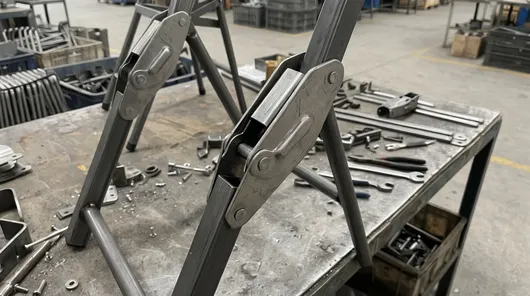
Folding Chair Manufacturing
Folding chairs are one of the highest-volume segments in our chair mechanism line. The hinge is the structural heart of a folding chair — it carries the full seat load in use and must fold flat reliably for storage and transport. Buyers in this segment are typically supplying event rental companies, institutional buyers (schools, government, hospitality), and mass-market retailers.
Event rental companies and institutional buyers order in container loads and reorder every 18–24 months as their fleet rotates. If your folding chair hinge fails in the field — a cracked pivot, a hinge that won't fold flat after 500 cycles — you're looking at warranty replacements and a lost reorder. The hinge spec is your warranty cost control.
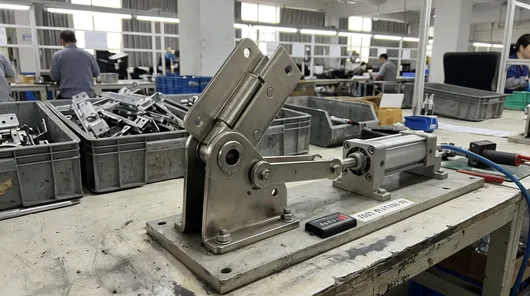
Reclining Chair and Sofa Mechanism Assembly
Recliner manufacturers and sofa mechanism assemblers use chair mechanism hinges as the pivot point between the seat frame and the reclining backrest or footrest linkage. These applications put the hinge under cyclic load in a specific arc — the pivot needs to rotate smoothly through the full recline range without developing play over time.
For recliner applications, we typically supply hinges with a 10mm or 12mm pivot bore in Q235 steel, with nickel plating for corrosion resistance and dimensional stability. The heavier bore diameter distributes the cyclic load over a larger contact area, which is what extends cycle life in this application.
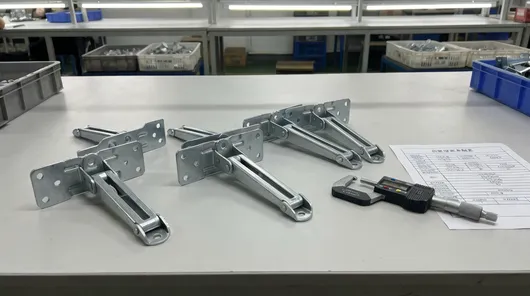
OEM Chair Assembly — Replacement and Upgrade Components
A significant portion of our chair mechanism hinge volume goes to buyers who manufacture their own chair assemblies and need a reliable component source for the pivot hardware. This includes furniture manufacturers who design their own chair frames but source mechanism components externally, and distributors who stock replacement parts for existing chair lines.
The key sourcing requirement is batch-to-batch dimensional consistency — your assembly jigs are set up for a specific hole pattern and bore diameter, and variation between orders means your line stops to re-adjust. Progressive die stamping delivers that consistency: the bore, mounting holes, and plate geometry are all cut in the same press stroke, so every hinge in a 10,000-unit run is dimensionally identical to the first one.
Manufacturing Process
How We Stamp and Finish Chair Mechanism Hinges
Every hinge starts as cold-rolled steel coil stock and passes through a controlled sequence of stamping, deburring, and surface finishing before it ships. Each step has a direct consequence for dimensional consistency, cycle life, and corrosion performance in your application.
Progressive Die Stamping
The hinge body is formed on progressive die presses from cold-rolled steel coil stock. Progressive dies produce the complete hinge geometry — pivot bore, mounting holes, relief cuts, and edge profile — in a single pass through the press. This matters for two reasons: dimensional consistency across a production run (no operator-dependent variation between pieces), and cycle time (a single-pass progressive die is faster than multi-step CNC operations, which keeps your unit cost down on volume orders).
In-House Tooling — No Re-Tooling Lead Time on Reorders
We maintain tooling for our standard hinge range in-house. When you reorder, we're running the same die that produced your last batch — no re-tooling lead time, no dimensional drift between orders. For custom hinge geometries, our tooling team cuts new dies in-house, which means faster sample iterations than working through a third-party tool shop.
Deburring and Edge Treatment
After stamping, hinges go through deburring and edge treatment before surface finishing. A sharp edge at the pivot bore causes accelerated wear on the pivot pin and can create stress concentration points that initiate fatigue cracks. We run a controlled deburring pass on every hinge before it goes to the plating or powder coat line.
Surface Finishing — Full In-House Line
Surface treatment is full in-house: zinc plating, nickel plating, and powder coating. The powder line runs at 60–80μm film thickness, which is the range that passes 500-hour salt spray testing without adhesion failure.
For hinges going into coastal markets or humid environments, we recommend nickel plating over powder coat — the plating layer is thinner and more dimensionally stable, and the corrosion resistance is comparable for indoor furniture applications.

We've had buyers switch to us specifically after experiencing dimensional drift from factories using CNC drilling on individual parts — the difference shows up immediately on the assembly line. Progressive die stamping eliminates operator-dependent variation by cutting bore, mounting holes, and plate geometry in the same press stroke.
OEM & Custom Orders
Customization Options and OEM Tooling
Standard catalog hinges cover the most common pivot bore diameters, mounting patterns, and load ratings. If your chair design needs something outside the standard range, we have the tooling capability to develop it.
| Customization Dimension | Standard Range | Custom Capability |
|---|---|---|
| Pivot bore diameter | 8 mm, 10 mm, 12 mm | Any diameter; tooling required |
| Hinge body thickness | 2.0 mm, 2.5 mm, 3.0 mm | Up to 4.0 mm; confirm with engineering |
| Mounting hole pattern | Standard 4-hole | Any pattern; tooling required |
| Material grade | SPCC, Q235 | Higher-grade steel on request |
| Surface treatment | Zinc plate, nickel plate, powder coat | Custom RAL colors (500+ unit runs) |
| Branding / marking | None (standard) | Laser marking or stamped logo available |
| MOQ (standard catalog) | 500 units | — |
| MOQ (custom tooling) | Flexible; based on tooling amortization | Discuss during quoting |
OEM Drawing Review
For OEM projects, send us your drawing or a reference sample. Our engineering team reviews for manufacturability — we'll flag anything that will cause production problems before tooling is cut, not after. First samples on new tooling typically run 25–35 days from drawing approval, depending on complexity.
Private-Label Packaging
Private-label packaging is available for buyers who need branded cartons or retail-ready presentation. This is handled as part of the OEM arrangement.
Ready to discuss a custom hinge specification? Send us your drawing or sample for a feasibility assessment and quote.
Send Drawing or SampleMarket Access
Compliance and Certification for Your Target Markets
Chair mechanism hinges sold into commercial and institutional markets need to meet the compliance requirements of the destination market. Here's what we carry and what it covers for your downstream customers.
CE Marking
Required for furniture hardware sold into the EU. Our hinges carry CE marking, and the declaration of conformity ships with the order. Your EU importer or customs broker gets the documentation without chasing us after the fact.
SGS Testing
Third-party structural and cycle-life testing through SGS. Test reports are available with shipment. If your buyer or end customer requires independent test documentation, this is what you provide.
RoHS Compliance
No restricted substances in the surface treatment. Our zinc plating line uses trivalent chromium passivation — no hexavalent chromium. For buyers supplying into the EU or California markets, the RoHS documentation ships with the order.
ISO 9001:2015
The quality management framework governing our production and inspection process. This is the certification your procurement team needs to qualify us as a supplier.
Additional Market-Specific Standards
If your target market requires additional testing — EN 1335 for European office furniture, BIFMA X5.1 for North American commercial seating, or market-specific standards — we can arrange third-party testing through our existing SGS relationship. Specify the standard in your purchase order and we'll build the testing into the production schedule.
Sourcing Guidance
Frequently Asked Questions — Chair Mechanism Hinge Sourcing
What material thickness should I specify for a chair mechanism hinge in a commercial folding chair?
For standard commercial folding chairs rated to 120 kg, 2.0–2.5mm SPCC cold-rolled steel at the pivot zone is the right spec. For heavy-duty institutional applications — school cafeterias, event venues with high turnover — move to 2.5–3.0mm Q235. The thickness at the pivot zone specifically is what matters; the rest of the hinge body can be lighter. If you're unsure, send us your chair frame drawing and rated load — we'll recommend the configuration based on the actual stress distribution.
What is the difference between zinc plating and powder coating for chair hinges, and which should I specify?
Zinc plating deposits a thin metallic layer (typically 8–12μm) that provides corrosion resistance without meaningfully changing the part dimensions. Powder coating adds 60–80μm of polymer film, which gives better cosmetic finish and color options but affects fit on tight-clearance assemblies. For hinges where the pivot pin is a close-tolerance fit, specify zinc or nickel plating. For hinges where appearance matters and dimensional tolerance is less critical, powder coat is fine. Most of our commercial folding chair hinges ship zinc-plated.
How do I prevent chair mechanism hinges from developing play over time in high-use environments?
Play develops when the pivot bore elongates under cyclic load — the pin rocks rather than rotates, and the bore wears oval. Three things prevent it: sufficient material thickness at the pivot zone (2.0mm minimum for standard duty), a bore tolerance tight enough that the pin rotates without radial play (±0.15mm is the threshold), and a hardened steel pin rather than a mild steel pin. If you're specifying hinges for 24/7 or institutional environments, also specify 100,000-cycle testing rather than the standard 60,000-cycle floor.
Can I order chair mechanism hinges as standalone components rather than as part of a complete mechanism assembly?
Yes. Hinges are available as standalone components — this is common for buyers who manufacture their own chair assemblies or need replacement parts for existing lines. MOQ on standalone hinge components is typically lower than on complete mechanism assemblies. Contact us with your part requirements and we'll quote accordingly.
What is the lead time for a custom chair mechanism hinge with non-standard bore diameter or mounting pattern?
New tooling runs 25–35 days from drawing approval to first sample, depending on complexity. After sample approval, production lead time for bulk orders is 25–35 days from order confirmation and deposit. If you need to move faster on the sample stage, send us a reference part — we can often match an existing geometry without cutting new tooling, which eliminates the tooling lead time entirely.
Complete Your Sourcing
Related Chair Mechanism Components
If you're sourcing chair mechanism hinges, you may also need these components from the same category.
Chair Mechanism Lock
Tilt-lock, position-lock, and swivel-lock components. Available standalone or integrated into mechanism assemblies.
Chair Mechanism Plate
Stamped steel mounting plates in standard and custom hole patterns. The structural base that the hinge mounts to.
Chair Mechanism Backrest
Backrest brackets, tilt arms, and angle-adjustment hardware that work in conjunction with the hinge pivot.
Folding Chair Mechanism
Complete fold-flat bracket systems if you need the full assembly rather than individual hinge components.
Get a Quote for Chair Mechanism Hinges
Most new buyers start with a sample order — 2–5 units across the configurations you're evaluating — to test fit and function against your chair frames before committing to production quantities. We can ship samples within 7–10 days of order confirmation.
Have a Drawing or Reference Sample?
Send it to us directly. Our engineering team will review it, confirm the right material and surface treatment spec for your application, and come back with a detailed quote.
Building a New Chair Line?
Tell us your rated load, end-use environment, and target price tier — we'll spec the configuration that fits.