Buyers get burned on tilt mechanisms more often than on almost any other chair component. Not because the mechanisms are complicated — they're not — but because the spec sheet conversation happens too late. Someone orders 2,000 units, the chairs arrive, and the tilt feels stiff for anyone under 60 kg or the lock clicks into only two positions when the end customer expected four. By then, you're looking at a rework cost or a return conversation you didn't budget for.
The three parameters that determine whether a tilt mechanism fits your product are tilt angle range, lock position count, and spring tension range. Get those three right at the RFQ stage and the rest of the spec sheet is mostly confirmation. Get them wrong and no amount of good surface finish saves you.
This guide walks through each parameter in sourcing terms — what the numbers mean, how they connect to compliance requirements like EN 1335 and BIFMA, and what to ask a supplier before you commit to tooling.
—
What the core spec parameters actually control
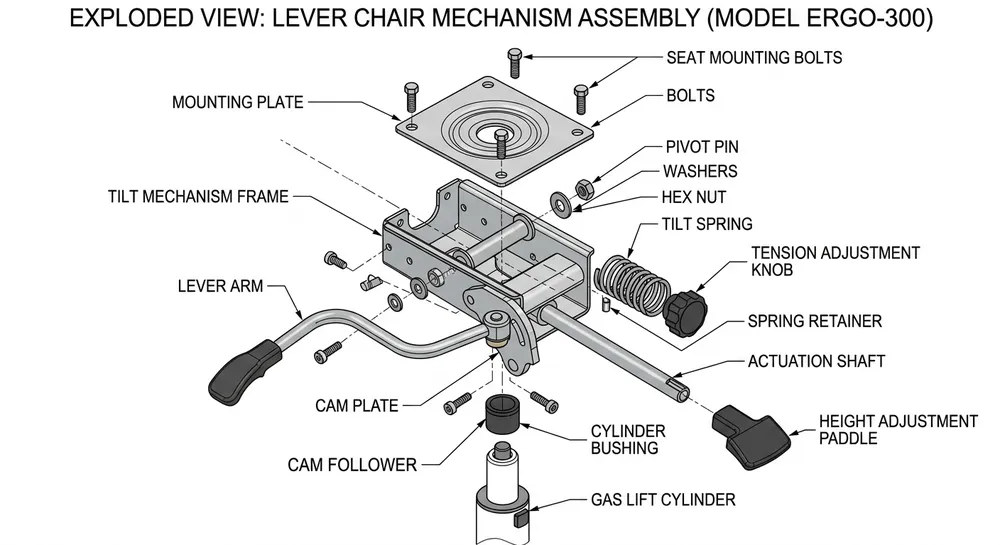
A tilt mechanism does one job: it lets the seat and backrest rotate backward under the user's weight, then returns to upright when the user leans forward. The three parameters below define how that motion behaves in practice.
Tilt angle range sets the physical travel — how far back the chair can recline. Lock positions determine where in that travel the user can fix the chair. Spring tension controls how much resistance the user feels throughout the motion. These three interact: a wide tilt range with too few lock positions leaves users unable to hold a mid-recline posture; a correctly tensioned spring in the wrong weight class makes the mechanism feel broken even when it's mechanically perfect.
For your product line, the question isn't which values are "best" — it's which combination matches your target market's ergonomic expectations, compliance requirements, and price tier.
—
Tilt angle range: what the degrees mean for your product
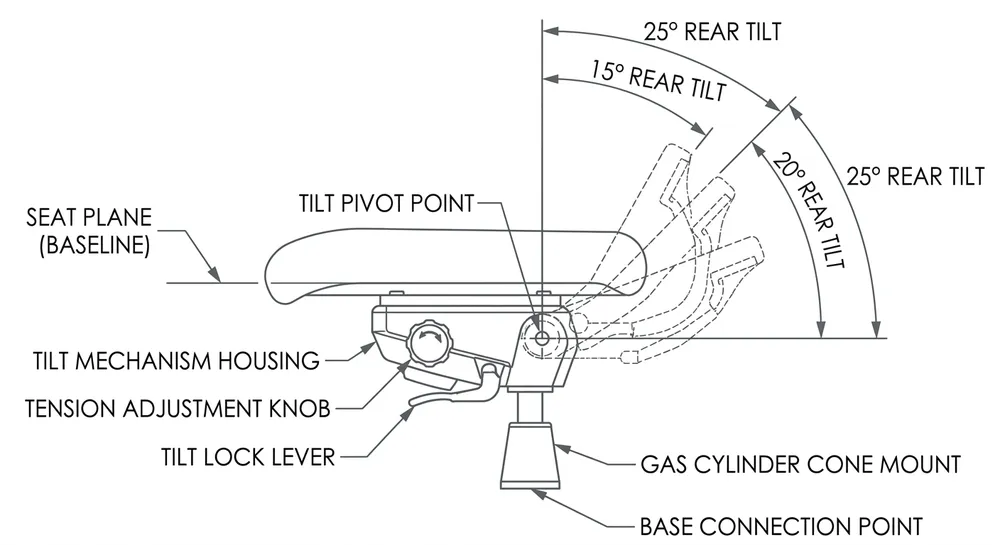
Most commercial tilt mechanisms ship with a rear tilt range of 15° to 25°. That range covers the majority of task chair applications and sits within the motion envelope required by EN 1335-1 (European office chair standard) and BIFMA X5.1 (North American commercial seating standard).
| Tilt range | Typical application | Compliance note |
|---|---|---|
| 10°–15° | Budget task chairs, high-density seating | Below EN 1335 ergonomic recommendation for sustained use |
| 15°–20° | Standard commercial task chairs | Meets EN 1335 and BIFMA baseline |
| 20°–25° | Mid-to-premium ergonomic chairs | Preferred range for ergonomic certification claims |
| 25°–30° | Executive recliners, lounge-task hybrids | Requires heavier spring spec and reinforced pivot housing |
The 15°–20° range is where most volume orders land. If your buyer is targeting the European contract market and wants to make EN 1335 compliance claims on the product, 17°–20° rear tilt is the practical floor. Below that, the chair may pass structural testing but won't support the ergonomic posture language your buyer wants on the spec sheet.
One thing worth knowing: tilt angle is measured from the seat plane, not from vertical. Suppliers who quote "30° tilt" without clarifying the reference plane may be measuring differently. Ask for the measurement reference in writing.
(We've seen this cause real confusion on export documentation — a 25° seat-plane tilt and a 25° backrest-angle tilt are not the same chair.)

For OEM buyers who need a specific tilt range outside the standard window — say, 22° for a particular ergonomic certification claim — that's adjustable at the tooling stage. We can modify the travel stop on the pivot housing. The minimum run for a custom tilt range is typically 500 units, which is our standard MOQ for modified configurations.
—
Lock positions: count, placement, and what commercial buyers actually need
Lock positions are the fixed points where the tilt mechanism can be held in place. The user engages a lever or paddle to lock the seat at a chosen recline angle. Standard commercial mechanisms ship with 2 to 5 lock positions.
| Lock count | Typical use case | Market fit |
|---|---|---|
| 2 positions | Budget seating, upright + one recline | Entry-level, price-sensitive markets |
| 3 positions | Standard task chairs | Mid-market commercial, education |
| 4 positions | Ergonomic task and executive chairs | Contract office, healthcare, premium retail |
| 5 positions | High-adjustability ergonomic chairs | Premium ergonomic, government procurement |
The gap in the market is at 4 positions. Most buyers sourcing for the North American or European contract office segment want 4-position lock as a baseline — it's what end users expect from a chair priced above $200 retail. Two-position mechanisms are fine for budget hospitality or high-density education seating where adjustability isn't a selling point.
Lock engagement mechanism matters as much as count. There are two common types:
- Ratchet-style lock: engages at fixed detents as the user reclines. Simple, low-cost, reliable. The click is audible and tactile. Works well for standard task chairs.
- Infinite-position lock (tilt limiter): the user can lock at any point in the travel range. More complex, higher component cost, preferred for premium ergonomic applications.
For most commercial volume orders, ratchet-style at 3–4 positions is the right call. Infinite-position lock adds cost and a more complex assembly step — it makes sense when your buyer is positioning the chair as a premium ergonomic product and the price tier supports it.
Durability is where lock mechanisms separate good suppliers from bad ones. The lock pawl and detent plate take repeated engagement loads across the chair's service life. We run our lock assemblies through 50,000 engagement cycles as part of standard QC — that's the BIFMA X5.1 durability floor, and we treat it as a minimum, not a target. (Some suppliers quote cycle life on the tilt pivot only, not on the lock assembly specifically. Ask which component the cycle count applies to.)
—
Spring tension: matching resistance to your user weight class
Spring tension is the parameter buyers most often under-specify. The mechanism arrives, the tilt works, but the chair feels wrong — too stiff for lighter users, too loose for heavier ones. That's a spring rate mismatch, and it's entirely avoidable at the sourcing stage.
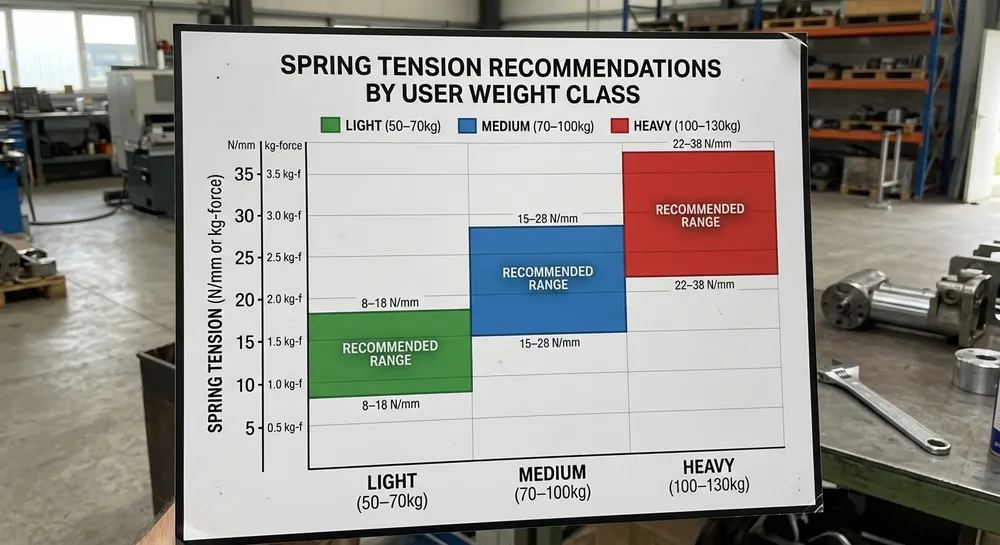
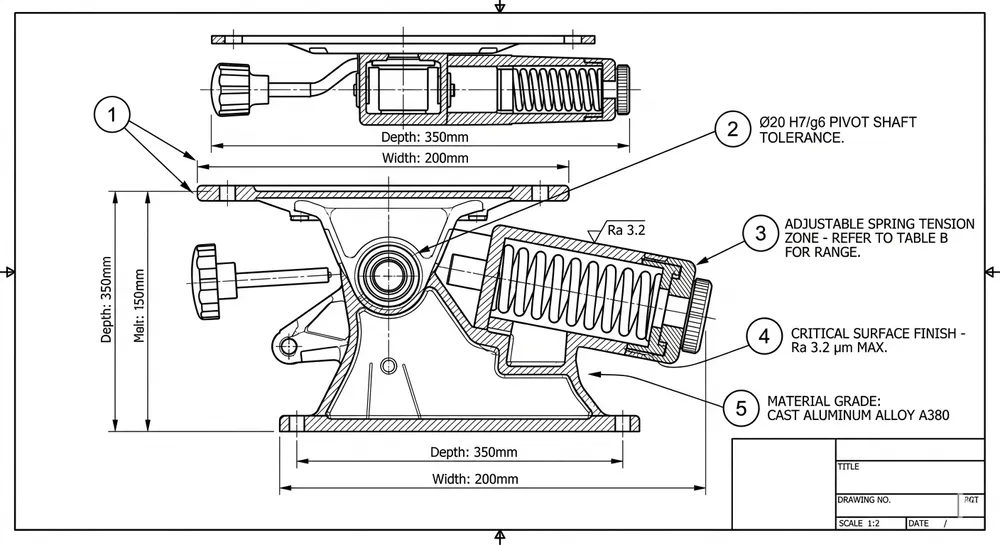
Standard commercial tilt mechanisms use a coil spring or gas spring to provide return force. The relevant spec is spring rate — the force required to compress the spring per unit of travel, typically expressed in N/mm or as a weight-class rating.
| User weight class | Recommended spring rate | Adjustment range needed |
|---|---|---|
| Light (50–70 kg) | Low: 1.5–2.5 N/mm | ±20% via tension knob |
| Medium (70–100 kg) | Standard: 2.5–4.0 N/mm | ±25% via tension knob |
| Heavy (100–130 kg) | Heavy: 4.0–6.0 N/mm | ±30% via tension knob |
| Mixed / adjustable | Adjustable range: 1.8–5.5 N/mm | Lever or multi-turn knob |
Most commercial task chairs ship with a medium spring rate and a tension adjustment knob that gives the user roughly ±25% adjustment range. That covers the 70–100 kg user well and extends usably into the 60–110 kg range. If your target market skews lighter (common in Southeast Asian markets) or heavier (common in North American contract seating), specify the spring rate explicitly rather than accepting the supplier's default.
Adjustment mechanism type also affects your product positioning:
- Tension knob (multi-turn): standard on most commercial chairs. The user turns a knob under the seat to increase or decrease spring preload. Low cost, reliable, familiar to end users.
- Lever-style tension: faster to adjust, preferred in premium ergonomic applications. Higher component cost.
- Fixed tension (no adjustment): used in budget seating where simplicity and cost reduction matter more than adjustability.
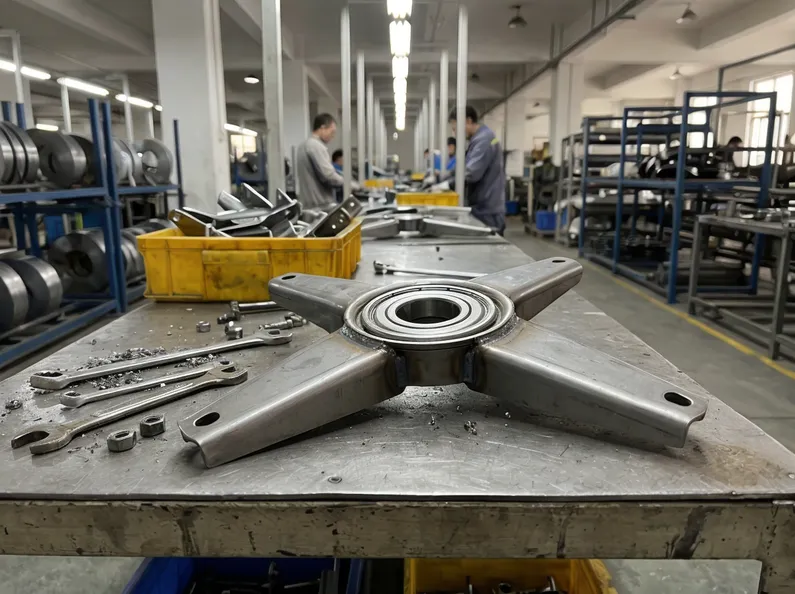
We die-cast our spring tension housings in-house. The reason that matters to you: spring rate consistency batch-to-batch depends on dimensional accuracy of the spring seat and housing bore. When those dimensions drift — which happens with outsourced castings — the effective spring rate shifts even if the spring wire spec is identical. Our in-house die-casting holds the housing bore to ±0.05 mm, which keeps spring rate variation within ±3% across a production batch. For a buyer selling into the contract office market where consistent feel across a 500-unit installation matters, that's not a minor detail.
For buyers who need a non-standard spring rate — say, a heavy-duty spec for a 130 kg+ rated chair targeting the North American market — we can adjust the spring specification and housing geometry via ODM. See our Tilt Chair Mechanism product page for standard configurations, or send us your weight class and target feel for a custom spring rate recommendation.
—
Load rating and cycle life: the spec floor for commercial sourcing
Load rating and cycle life are the two numbers that determine whether a mechanism is commercially viable or a warranty liability.
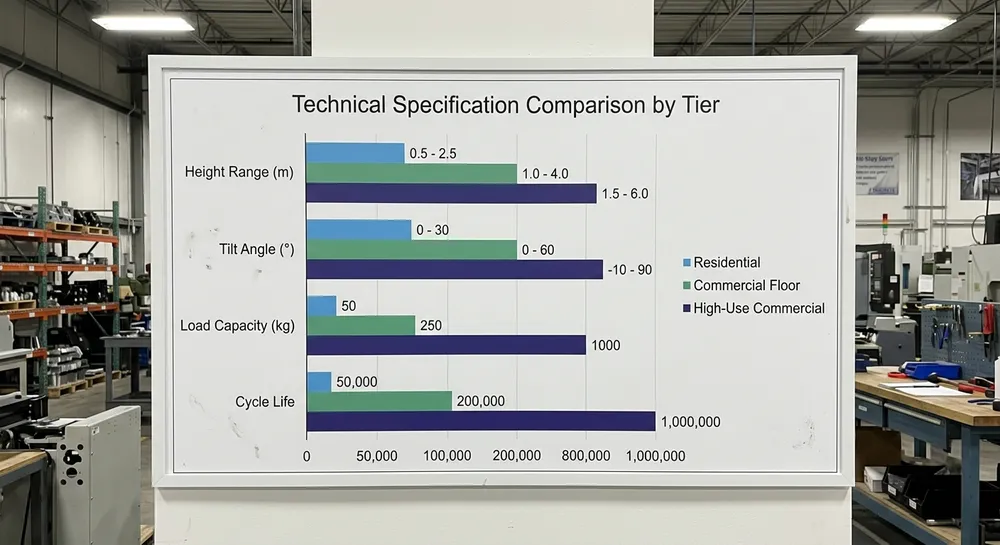
Load rating for commercial office chair mechanisms should be a minimum of 100 kg dynamic load. Most contract office specifications require 110–120 kg. If you're targeting BIFMA-compliant products for the North American market, 113 kg (250 lbs) is the standard test load. EN 1335 uses 110 kg for the primary test load.
Cycle life is the number of full tilt cycles the mechanism must complete without failure. BIFMA X5.1 requires 50,000 cycles minimum. EN 1335-3 requires similar durability testing. We run 50,000-cycle testing on every mechanism configuration as standard — not as a certification exercise, but because it's the only way to catch fatigue failures in the pivot housing and lock assembly before they reach your customer.
| Spec parameter | Commercial minimum | Contract/premium target | MVMHardware standard |
|---|---|---|---|
| Dynamic load rating | 100 kg | 110–120 kg | 120 kg |
| Cycle life (tilt pivot) | 50,000 cycles | 100,000 cycles | 50,000 cycles (standard) |
| Lock engagement cycles | 20,000 cycles | 50,000 cycles | |
| Surface treatment | Zinc plating or powder coat | Nickel plating | Zinc / nickel / powder coat options |
When you request a spec sheet from any supplier, ask for the load rating test report and the cycle life test report separately. Some suppliers quote a single "durability test" number that combines both — that's not the same as independent verification of each failure mode. The pivot housing and the lock assembly fail differently and should be tested independently.
(We've had buyers come to us after a previous supplier's mechanism passed a combined durability test but showed lock pawl wear at 15,000 cycles in field use. The combined test masked the lock assembly weakness.)
—
How tilt mechanism specs connect to EN 1335 and BIFMA compliance
If your buyer is selling into the European contract market or North American commercial segment, compliance eligibility starts at the mechanism spec level — not at the finished chair level.
EN 1335 (European office chair standard) covers three parts: dimensions and safety (Part 1), test methods (Part 2), and safety requirements (Part 3). For tilt mechanisms, the relevant requirements include:
- Minimum tilt range supporting ergonomic posture (typically 15°+ rear tilt)
- Structural integrity under 110 kg dynamic load
- Durability under repeated use cycles
- Stability requirements that interact with tilt range and spring return force
BIFMA X5.1 (North American commercial seating) sets similar structural and durability floors, with a 113 kg test load and 50,000-cycle minimum.
The practical implication: if your buyer wants to make EN 1335 or BIFMA compliance claims, the mechanism you source needs to meet the structural and durability floors before the chair goes to a test lab. A mechanism that fails at 30,000 cycles or under 100 kg load won't pass the finished chair test regardless of how well the rest of the chair is built.
We hold ISO 9001:2015, CE, and SGS certifications. CE marking on our mechanisms means the structural and safety requirements have been independently verified — which simplifies your compliance documentation when the finished chair goes to certification. For buyers targeting specific market certifications, we can provide test reports and dimensional inspection documentation at the RFQ stage.
For a deeper look at how tilt mechanisms compare to synchro mechanisms for different compliance scenarios, see our tilt vs synchro mechanism guide.
—
Sourcing checklist: what to confirm before placing a tilt mechanism order
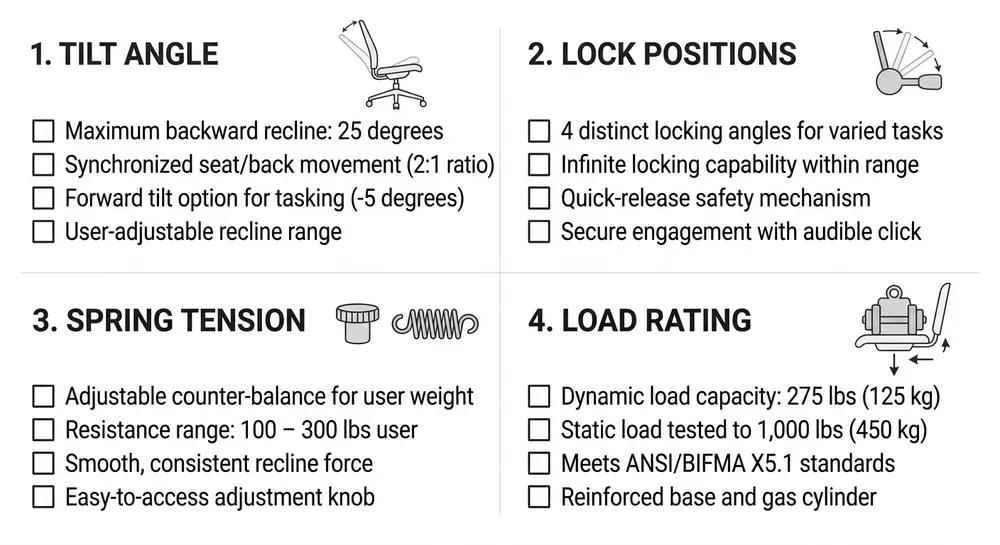
Most sourcing problems with tilt mechanisms come from skipping the spec confirmation step. Here's what to lock down before you commit to an order:
Tilt angle range
- [ ] Confirm the measurement reference (seat plane vs. backrest angle)
- [ ] Confirm the exact travel range in degrees
- [ ] Confirm whether the range is fixed or adjustable via travel stop
- [ ] If custom range needed: confirm ODM tooling lead time and MOQ
Lock positions
- [ ] Confirm lock count and position spacing (degrees between each lock)
- [ ] Confirm lock mechanism type (ratchet vs. infinite)
- [ ] Request lock engagement cycle test report (separate from tilt pivot cycle test)
- [ ] Confirm engagement force (should be consistent across all positions)
Spring tension
- [ ] Specify target user weight class
- [ ] Confirm spring rate (N/mm) and adjustment range
- [ ] Confirm adjustment mechanism type (knob, lever, or fixed)
- [ ] Request batch-to-batch spring rate variation data
Load rating and cycle life
- [ ] Request load rating test report (dynamic, not static only)
- [ ] Request tilt pivot cycle life test report
- [ ] Request lock assembly cycle life test report (separate document)
- [ ] Confirm test standard used (BIFMA X5.1, EN 1335-3, or internal)
Surface treatment and finish
- [ ] Confirm surface treatment type (zinc plating, nickel plating, powder coat)
- [ ] Request salt spray test hours if corrosion resistance matters for your market
- [ ] Confirm finish consistency across batch (especially for visible components)
If a supplier can't provide separate test reports for the tilt pivot and lock assembly, that's a signal worth taking seriously. It doesn't mean the product is bad — but it means you're accepting more uncertainty than you need to.
—
OEM and ODM customization: adjusting specs for your market
Standard tilt mechanisms cover most commercial applications. But if your product line has specific requirements — a particular tilt range for an ergonomic certification claim, a custom lock count for a premium product tier, or a heavy-duty spring spec for a high-weight-class market — those are adjustable.
We support ODM customization on:
- Tilt angle range: travel stop modification on the pivot housing, typically ±5° from standard range
- Lock position count: from 2 to 5 positions, with custom position spacing available
- Spring rate: adjusted via spring wire spec and housing geometry, matched to your target weight class
- Surface treatment: zinc plating, nickel plating, or powder coat — all processed in-house
ODM tooling for a modified tilt mechanism typically requires a minimum run of 500 units for standard modifications. More significant geometry changes (custom pivot housing, non-standard lock plate) require a tooling discussion and a sample approval stage before production.
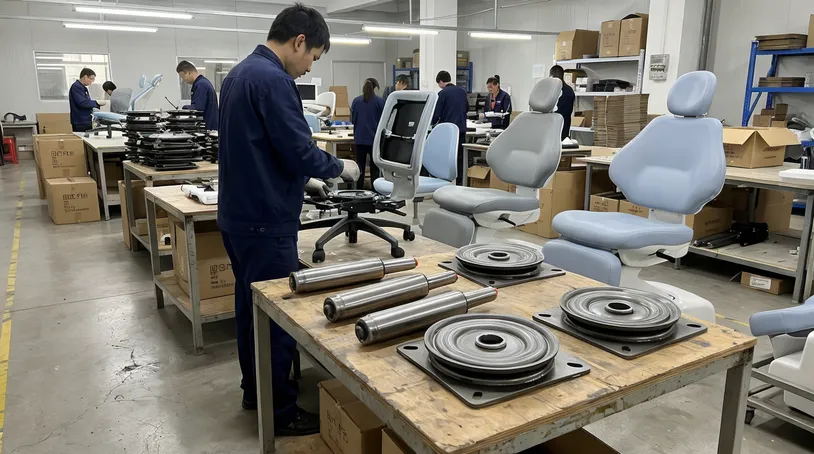
Our in-house R&D team has 12 engineers focused on motion hardware. When a buyer sends us a target spec — tilt range, lock count, weight class, compliance target — we return a mechanism recommendation with dimensional drawings and a sample quote. That process doesn't require a large commitment upfront; most buyers start with a sample order to verify the feel before committing to production volume.
For buyers evaluating spring rate options across different weight classes, our spring rate selection guide covers the selection logic in more detail.
—
Frequently asked questions
What tilt angle range do I need for EN 1335 compliance?
EN 1335-1 recommends a minimum rear tilt range that supports ergonomic seated posture. In practice, mechanisms with 15°–20° rear tilt (measured from the seat plane) meet the structural and dimensional requirements. If your buyer wants to make explicit ergonomic certification claims, 17°–20° is the practical floor. Below 15°, the chair may pass structural testing but won't support the ergonomic posture language the standard is designed to enable.
How many lock positions does a commercial office chair mechanism need?
For standard commercial task chairs, 3–4 lock positions is the market expectation in North America and Europe. Two-position mechanisms are acceptable for budget or high-density seating where adjustability isn't a selling point. Five-position mechanisms are used in premium ergonomic applications. If your buyer is targeting the contract office segment at mid-to-premium price points, specify 4 positions as your baseline.
What spring tension should I specify for a chair rated to 120 kg?
For a 120 kg rated chair, specify a heavy spring rate in the 4.0–6.0 N/mm range with a tension adjustment range of ±30%. This gives users in the 90–130 kg range a usable adjustment window. If the chair will be sold into a mixed-weight market, an adjustable spring mechanism with a range of 1.8–5.5 N/mm covers more of the user population without requiring separate SKUs.
What's the difference between a tilt mechanism and a synchro mechanism for B2B sourcing?
A tilt mechanism rotates the seat and backrest together from a single pivot point. A synchro mechanism uses a linkage that moves the seat and backrest at different rates — typically a 2:1 or 3:1 ratio — so the backrest reclines further than the seat tilts. Synchro mechanisms cost more and are preferred for premium ergonomic applications. For most commercial task chair volume, tilt mechanisms are the right cost-performance choice. See our tilt vs synchro mechanism comparison for a full breakdown.
Can I request a custom tilt range or lock count for an OEM order?
Yes. Tilt range and lock count are both adjustable via ODM tooling. Standard modifications — adjusting the travel stop for a different tilt range, or changing the lock plate for a different position count — are available from 500 units. More significant geometry changes require a tooling discussion and sample approval. Send your target specs to our Chair Mechanism team and we'll confirm what's achievable within your volume and timeline.
What documents should I request from a tilt mechanism supplier?
At minimum: a load rating test report (dynamic, not static only), a tilt pivot cycle life test report, and a lock assembly cycle life test report as a separate document. If you're targeting EN 1335 or BIFMA compliance, also request the test standard reference and the test lab name. For surface treatment, request salt spray test hours if your market has corrosion exposure. If the supplier can't provide these documents separately, ask why — the answer tells you something about their QC process.
—
If your sourcing review has reached the point where you're comparing specific tilt angle ranges, lock counts, and spring rates, you're ready for a mechanism recommendation. Send your target specs — tilt range, lock position count, user weight class, annual volume, and target compliance standard — to our team via Request Quote and we'll return a specific mechanism configuration with dimensional drawings and pricing.