

Chair Mechanism Backrest
Stamped steel backrest mechanism components — brackets, pivot arms, and angle-adjustment hardware built to the same tolerances as our complete mechanism assemblies.
Sourced individually or as part of a complete mechanism kit. Every component 100% functionally verified before shipment. OEM geometry and custom mounting patterns supported.

Component Definition
What a Chair Mechanism Backrest Component Actually Is — and Why Buyers Source It Separately
The chair mechanism backrest is the hardware assembly that connects the backrest shell to the seat mechanism and controls how the backrest moves — its tilt angle, its pivot point, and whether it locks at a fixed position or floats freely. It's not the backrest cushion or shell. It's the metal bracket, pivot arm, and adjustment hardware that determines whether the backrest functions correctly over the life of the chair.
We produce backrest mechanism hardware as both standalone components and as integrated parts of our complete chair mechanism assemblies. The same progressive die stamping process, the same ±0.15mm tolerance, the same surface treatment lines — the component doesn't get a different standard because it's sold individually rather than as part of an assembly.
Request a Quote for Backrest Components
Chair Manufacturers Completing a Proprietary Design
Builders of their own seat mechanisms need backrest brackets and tilt arms that match their proprietary geometry — they're not buying a complete mechanism, they're completing one.
Importers & Distributors Servicing Existing Lines
Importers carrying existing chair lines need replacement components when a specific bracket or pivot arm becomes a warranty or service issue.
OEM Buyers Developing New Chair Models
OEM buyers developing new chair models need custom backrest geometry prototyped and tooled before committing to a complete mechanism design.
Technical Data
Backrest Mechanism Component Specifications
These are industry-standard parameters for the backrest bracket and tilt arm components we produce. Exact specifications vary by configuration — contact us with your requirements for a detailed data sheet.
Specifications shown are industry-standard values for this component type. Actual specifications depend on your configuration requirements. Contact us for exact product data sheets.
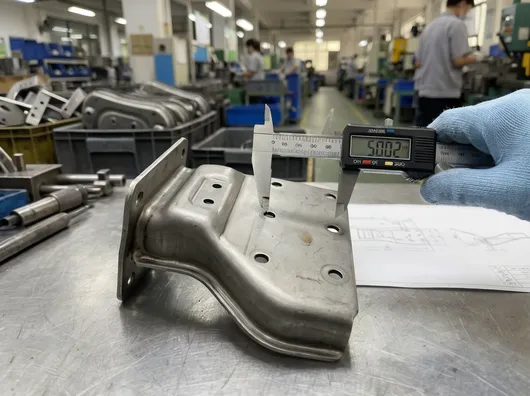
We hold ±0.15mm on all stamped bracket geometry — mounting holes, pivot slots, and stop-pin positions. That tolerance is what lets your assembly line use fixed jigs without per-piece adjustment.
If your current supplier's backrest brackets are causing fit variation on the assembly line, dimensional drift is almost always the root cause.
How We Stamp and Finish Backrest Brackets
The backrest bracket is a structurally loaded component. It carries the full moment load of a user leaning against the backrest — which, on a 100 kg user leaning at 15°, translates to meaningful bending stress at the pivot point. The manufacturing decisions that matter here are material grade, forming process, and weld quality at any structural joints.
Progressive Die Stamping
We stamp backrest brackets from cold-rolled steel coil on progressive dies. The progressive die process forms the complete bracket geometry — body profile, mounting holes, pivot bore, and any integrated stop features — in a single press sequence. This eliminates the dimensional variation that comes from multi-step processes where each operation introduces its own positioning error. A bracket stamped in a single progressive die sequence has its pivot bore and mounting holes in a fixed geometric relationship, every piece, every run.
Material Selection by Load Rating
SPCC cold-rolled steel at 2.0–2.5 mm body thickness.
Q235 at 3.0–3.5 mm. Past 3.5 mm body thickness, you're adding weight and freight cost without meaningful structural benefit for most applications. We'll tell you when it doesn't make commercial sense for your end market.

Weld Quality at Structural Joints
Where backrest brackets include welded sub-assemblies — pivot housings, stop-pin mounts, or integrated tilt-arm connections — those joints go through MIG welding with penetration verification.
The pivot housing weld is the highest-stress joint on the component. Weld cracking at the pivot under cyclic load is the most common field failure we see in competitor components that come through our lab. Insufficient penetration is the cause almost every time. We check penetration depth on structural welds — not just bead appearance.
Surface Treatment
For components where post-coating dimensional tolerance is critical.
60–80μm — passes 500-hour salt spray without adhesion failure. Relevant for coastal markets and humid climates where surface corrosion generates warranty claims.
Market Segments Where Backrest Components Drive Recurring Orders
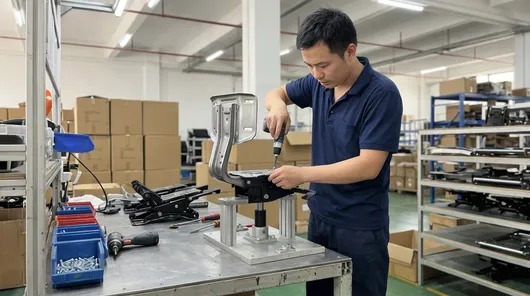
Chair Manufacturers Completing Their Own Mechanism Assemblies
Furniture manufacturers who produce their own seat mechanisms — particularly in Southeast Asia and Eastern Europe — frequently source backrest brackets and tilt arms from specialist component suppliers rather than stamping them in-house. The economics make sense when your production volume doesn't justify dedicated tooling for every bracket geometry in your chair line.
2,000–10,000 pieces per bracket type per quarter, with reorders tied to your own production schedule. Stamped to your drawings, consistent batch-to-batch dimensional accuracy.
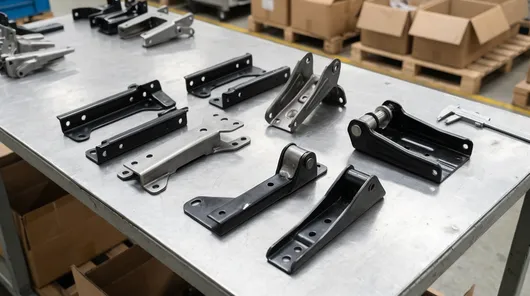
Replacement Parts for Existing Chair Lines
Importers and distributors who carry chair lines in North America, Europe, or Australia periodically need replacement backrest brackets when a specific component becomes a service issue — either through warranty claims or as a stocked spare part for their dealer network.
Replacement components carry better margin than OEM production quantities. Buyers who find a reliable source for a specific bracket geometry become consistent repeat customers.
500 pieces. We can match existing bracket geometry from a sample or drawing, and label for your brand if needed.
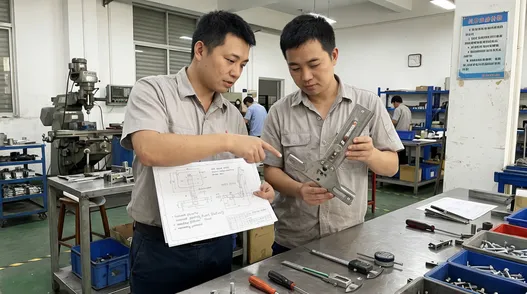
OEM Chair Development — New Models Requiring Custom Backrest Geometry
Chair brands developing new models often need custom backrest bracket geometry that doesn't exist in any standard catalog. The backrest pivot location, the tilt arc, the angle-stop positions — these are design decisions that differentiate one chair model from another.
Provide a drawing or reference sample with your modifications. Our engineering team reviews for manufacturability, cuts tooling, and runs first samples within 25–35 days. Custom geometry, your mounting pattern, your finish specification.
If your backrest design includes a custom adjustment knob or decorative cover, our in-house die-casting capability lets us develop that component in the same project cycle rather than sourcing it separately.
Tell us your development timeline and volume expectations — we'll structure the tooling arrangement accordingly.
Custom Engineering
Customization Options for Backrest Mechanism Hardware
Backrest brackets and tilt arms are among the most geometry-specific components in a chair mechanism. Standard catalog dimensions rarely fit a custom chair design without modification. Here's what we can adjust and what the practical limits are.
| Customization Dimension | Available Range | MOQ Impact |
|---|---|---|
| Bracket body geometry | Full custom per drawing | Tooling required; MOQ from 500 pcs |
| Mounting hole pattern | Any 4-hole or 6-hole layout; custom spacing | No tooling for standard patterns; custom patterns require tooling |
| Pivot bore diameter | Ø10 mm – Ø20 mm | Standard sizes: no tooling. Non-standard: tooling required |
| Tilt angle range | 0°–35° adjustable range | Angle stop positions set in tooling |
| Material grade | SPCC or Q235 | No MOQ impact — specify at order |
| Body thickness | 2.0 mm – 4.0 mm | No MOQ impact — specify at order |
| Surface finish | Zinc plate, nickel plate, powder coat (any RAL) | Custom RAL colors: 500-unit minimum per color |
| Branding / marking | Laser engraving or stamped logo | 1,000-unit minimum for stamped logo |
No-Tooling Modifications
Material grade, body thickness, and standard hole patterns can all be changed within the standard 500-unit MOQ — no tooling cost, no minimum uplift. Specify at order.
Tooling-Required Changes
Geometry changes that require new or modified tooling are quoted separately. We show you the actual die fabrication and setup breakdown — tooling cost is not a profit center here.
Need a custom bracket geometry?
Send us your drawing. We'll confirm what requires tooling, quote the tooling cost with a full breakdown, and work out per-unit amortization based on your projected volume.
Quality & Standards
Compliance and Certification for Backrest Mechanism Components
Backrest brackets and tilt arms are structural components — they're subject to the same load and cycle testing requirements as complete chair mechanisms in most market certification frameworks.
ISO 9001:2015
Quality management system governing production, inspection, and documentation across all backrest component manufacturing.
CE
European market compliance. Declaration of conformity available with every shipment for EU-bound orders.
SGS
Third-party audit and component testing. SGS reports available on request for buyers requiring independent verification.
RoHS
No hexavalent chromium in surface treatments. Trivalent chromium passivation on zinc plating line. Documentation ships with every order.
Market-Specific Standard Alignment
For buyers supplying into markets with specific chair safety standards, backrest bracket specifications need to align with the load and cycle requirements of those standards. We test to BIFMA X5.1 equivalent protocols as our standard QC floor.
European office chair standard. Load and cycle requirements apply to backrest bracket structural components.
Our standard QC floor. Commercial seating protocol for North American market. Third-party certification arrangeable via SGS.
Height-adjustable seating standard. Formal third-party certification to this standard can be arranged through our SGS relationship.
RoHS & Certification Documentation
RoHS documentation matters for EU and California-market buyers whose downstream customers require material compliance declarations. Our zinc plating line uses trivalent chromium passivation — no hexavalent chromium — and that documentation is available with every shipment. If your market requires formal third-party certification to a specific standard, we can arrange testing through our SGS relationship.
Integration with Complete Chair Mechanism Assemblies
Backrest mechanism components don't exist in isolation — they connect to seat plates, tilt mechanisms, and gas lift assemblies. Here's how they fit into the chair mechanism ecosystem.
Mechanism Plate Mount
The backrest bracket mounts to the rear of the chair mechanism plate — the stamped steel base that carries the full mechanism assembly. Pivot geometry between the bracket and plate determines the tilt arc and feel. When sourcing both components from us, we ensure pivot geometry is matched across parts.
Tilt Mechanism Compatibility
The tilt action is controlled by the seat mechanism — whether standard tilt, synchro mechanism, or push-back mechanism. The backrest bracket's pivot point and stop positions must be specified in relation to the tilt mechanism's geometry. We supply the complete assembly or individual components.
Angle Lock Integration
For backrest angle locking, the chair mechanism lock component integrates with the backrest bracket to provide fixed-position locking at specified angles. If you need locking at 90°, 100°, and 110° rather than floating freely, that's a lock component specification — worth clarifying before you finalize your component list.

Sourcing the Full Assembly vs. Individual Components
We can supply the complete assembly or the individual components — whichever fits your production model. When sourcing both the backrest bracket and the mechanism plate from us, we handle the geometric matching internally. You don't need to verify fit between components.
Frequently Asked Questions — Backrest Mechanism Components
What is the difference between a backrest bracket and a backrest tilt arm?
The backrest bracket is the structural mounting plate that connects the backrest shell to the chair mechanism — it carries the load and defines the pivot point. The tilt arm is the linkage that controls the backrest's range of motion and connects it to the seat mechanism's tilt action. In some mechanism designs these are a single integrated component; in others they're separate parts. When you send us your drawing or reference sample, we'll identify which components you need and quote accordingly.
What steel thickness should I specify for a commercial-grade backrest bracket?
For standard office task chairs (up to 100 kg rated load, 8-hour daily use), 2.0–2.5 mm SPCC is the industry-standard specification. For heavy-duty commercial applications — institutional seating, 24/7 environments, or chairs rated above 120 kg — specify 3.0–3.5 mm Q235. Going heavier than 3.5 mm adds freight cost without meaningful structural benefit for most applications. If you're unsure, send us your load rating and end-use environment — we'll recommend the right spec.
Can you match an existing backrest bracket from a sample?
Yes. Send us the physical sample or detailed dimensional drawings. Our engineering team will reverse-engineer the geometry, confirm the material spec, and quote against it. We do this regularly for buyers who need a reliable second source for an existing component or who are replacing a discontinued part from their current supplier.
What is the minimum order quantity for custom backrest bracket geometry?
For geometry that requires new tooling, the practical minimum is 500 pieces — that's the threshold where tooling amortization produces a unit cost that makes commercial sense. For modifications that don't require new tooling (material grade, thickness, standard hole patterns), the standard 500-unit MOQ applies without tooling cost. We'll tell you upfront which category your requirement falls into.
How do I ensure the backrest bracket I source will fit my existing chair mechanism plate?
Provide us with the mounting hole pattern and pivot bore dimensions from your existing mechanism plate. We'll confirm compatibility before production. If you're sourcing both the backrest bracket and the mechanism plate from us, we handle the geometric matching internally — you don't need to verify fit between components.
What surface treatment is best for backrest brackets going into humid or coastal markets?
Powder coating at 60–80μm passes 500-hour salt spray testing and is the standard recommendation for most markets. For coastal markets with high salt exposure — Southeast Asia, Australia, Gulf states — specify the full 80μm film thickness and confirm the pre-treatment wash step is included (it should be standard, but worth confirming with any supplier). Zinc plating is an alternative for components where post-coating dimensional tolerance is critical, but it offers less corrosion resistance than powder coat for outdoor or high-humidity environments.
Get Backrest Mechanism Components Quoted
Most buyers in this category start with a sample order — 5–10 pieces of the bracket configuration you're evaluating — to verify fit and finish against your chair frame before committing to production quantities.
Sample Orders
We ship 5–10 piece sample orders within 7–10 days of order confirmation. Verify fit and finish against your chair frame before committing to production quantities.
Have Drawings or a Sample?
Send them directly. We'll match your specification for bracket configuration, load rating, and surface treatment based on your reference.
Still Defining Your Spec?
Tell us your load rating, end-use environment, and target market. We'll recommend the bracket configuration and surface treatment that fits, based on what we're already shipping to buyers in your region.