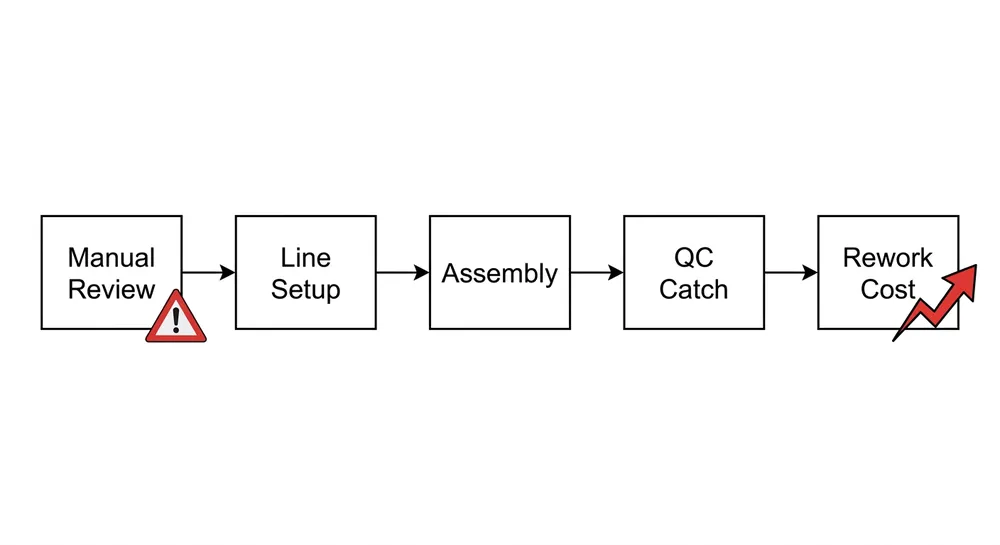
Most spec disputes we see at the RFQ stage come down to the same problem: the buyer is specifying the finished chair, not the mechanism. They'll send us a load rating pulled from a chair catalog — 150 kg, 250 lbs, whatever the product listing says — without knowing whether that number refers to the mechanism, the gas lift, the base, or some composite test of the whole assembly. By the time the order is placed and samples arrive, the mismatch is already baked in.
This article breaks down the actual spec parameters that matter at the mechanism level: what they measure, what the commercial thresholds look like, and what to include in your RFQ so you get an accurate quote the first time.
—
What "Swivel Chair Mechanism Specs" Actually Means at the Component Level
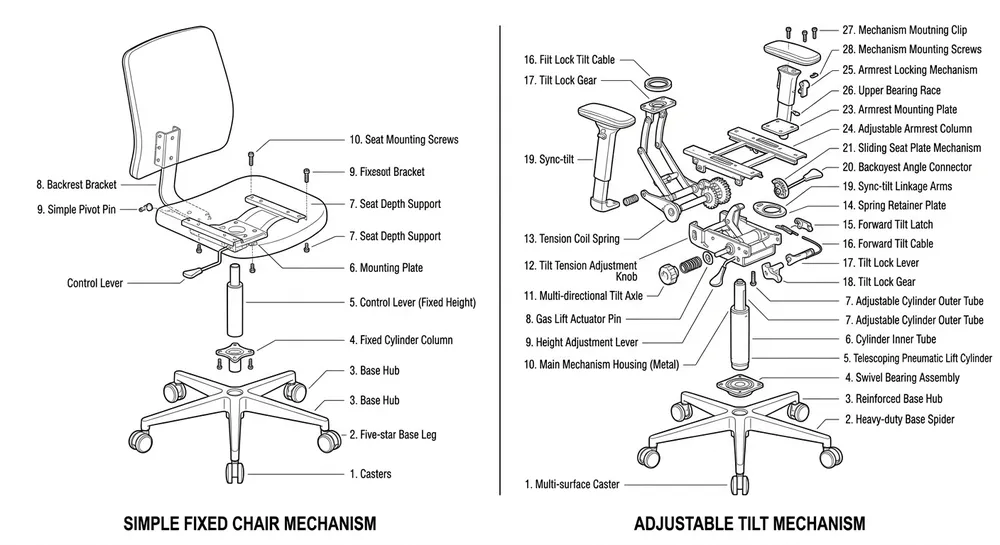
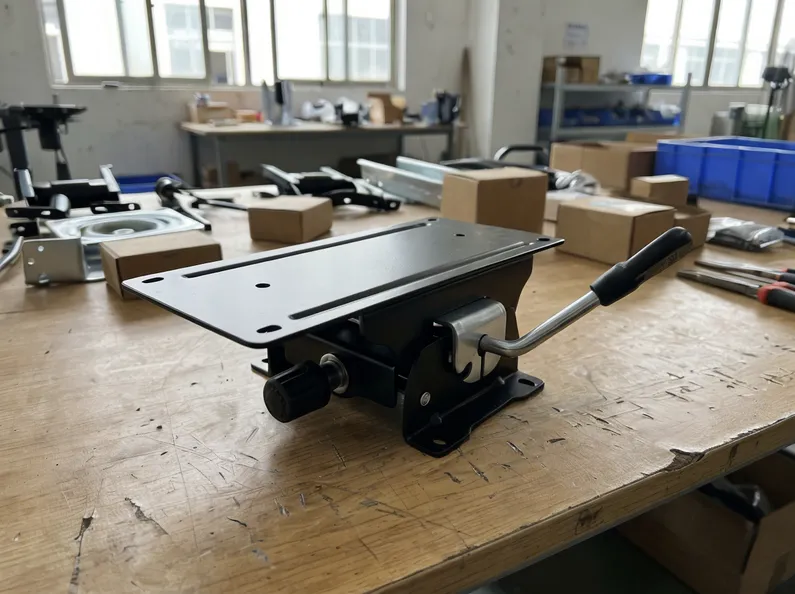
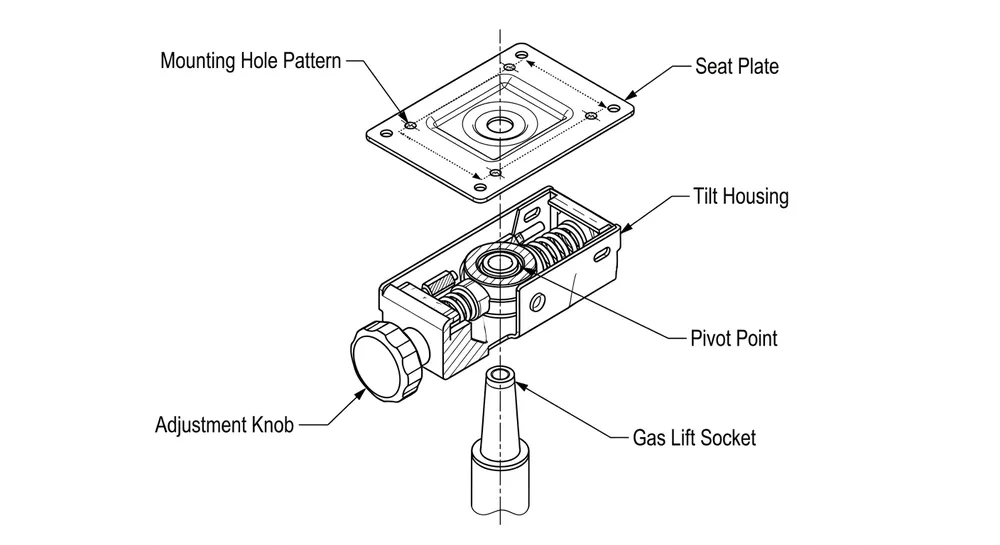
A swivel chair mechanism is the steel plate assembly that connects the seat to the gas lift column. It controls tilt angle, tilt resistance, seat height lock, and — in swivel-specific designs — the rotation interface between the seat plate and the base adapter. When someone says "swivel mechanism specs," they're talking about the performance envelope of that component in isolation, not the assembled chair.
The specs that matter for procurement are:
- Load rating — the static and dynamic weight the mechanism is rated to carry
- Rotation range — full 360° or limited-arc, and the tolerance on that range
- Cycle life — how many tilt/load cycles the mechanism is tested to before failure
- Mounting pattern — the bolt hole layout that determines compatibility with seat shells and bases
- Plate dimensions — overall footprint, which affects seat shell fit and packaging
- Surface treatment — finish type and corrosion resistance rating
Each of these has direct sourcing implications. Get one wrong and you're either over-specifying (paying for performance your market doesn't need) or under-specifying (warranty claims from your downstream customers).

—
Load Rating: What the Number Means and How It Affects Your Material Grade
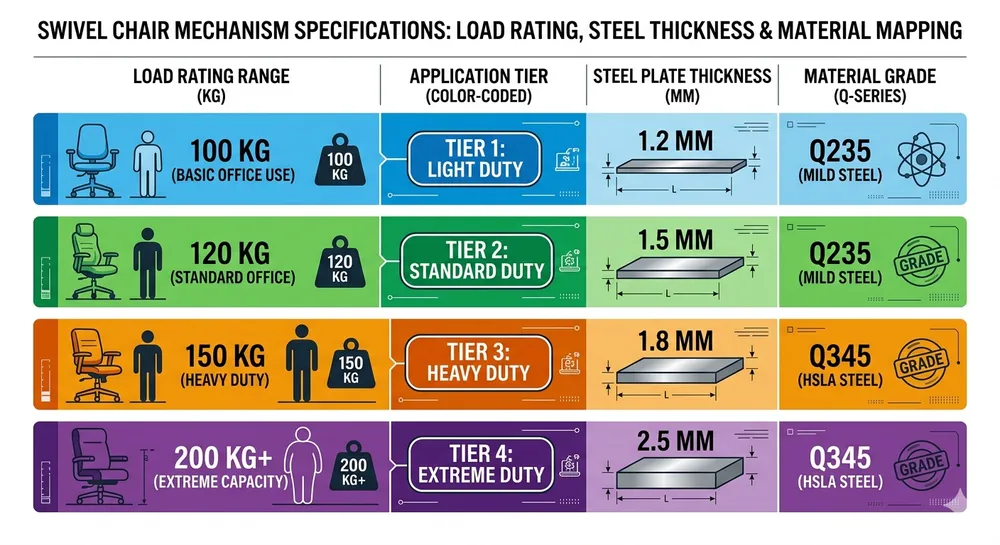
Load rating is the spec buyers ask about most and understand least. The number on a spec sheet — say, 150 kg — is a static load rating unless the document explicitly states otherwise. Static means the mechanism holds that weight without permanent deformation under a single sustained load. It says nothing about what happens over 50,000 tilt cycles with a 120 kg user.
For commercial procurement, you need both:
- Static load rating — structural integrity under maximum weight
- Dynamic load rating — performance under repeated cycling at rated load
The gap between these two numbers tells you a lot about the mechanism's actual construction. A mechanism with a 150 kg static rating and a 100 kg dynamic rating is built for residential use. One with matched static and dynamic ratings at 150 kg is built for commercial environments.
Load rating thresholds by market segment
| Application | Typical static load rating | Dynamic test standard | Material implication |
|---|---|---|---|
| Residential / home office | 100–120 kg | 50,000 cycles at 100 kg | 1.2–1.5mm cold-rolled steel plate |
| Commercial office | 120–150 kg | 100,000 cycles at 120 kg | 1.5–2.0mm plate, reinforced pivot |
| Heavy-duty / bariatric | 150–200 kg | 150,000 cycles at 150 kg | 2.0–2.5mm plate, dual-pivot design |
| Industrial / 24-hour use | 200 kg+ | 200,000+ cycles | Structural steel, full weld reinforcement |
The material grade selection follows directly from the load rating. At 120 kg and below, standard Q235 cold-rolled steel plate is sufficient. Above 150 kg, we move to Q345 or equivalent higher-yield steel on the seat plate and tilt housing — the geometry alone won't carry the load without the material upgrade.
(We've had buyers come to us with a 200 kg load requirement but a price target built around residential-grade mechanisms. Those two things don't coexist. The steel cost difference between Q235 and Q345 on a mechanism plate is real, and so is the tooling geometry change at the pivot point.)
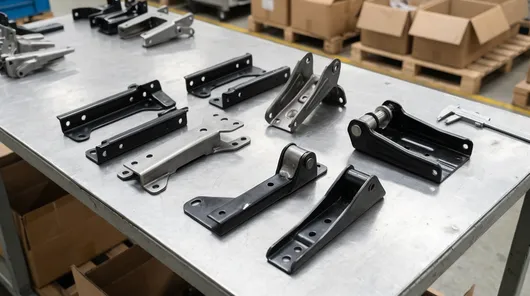
Our stamping tolerance of ±0.15mm on mechanism plates matters here more than it might seem. At higher load ratings, the load distribution across the mounting bolt pattern becomes uneven if the plate geometry is off. A plate stamped to ±0.5mm tolerance — which is common in lower-tier production — will show stress concentration at the bolt holes under repeated heavy loading. That's where fatigue cracks start.
—
Rotation Range: 360° Is Not Always the Same 360°
Full 360° rotation is standard on most swivel chair mechanisms, but "360°" on a spec sheet doesn't tell you much without the tolerance band. In production, rotation range is controlled by the interface between the swivel plate and the base adapter socket. Dimensional variation in that interface — from die-casting inconsistency or stamping tolerance stack-up — translates directly into rotation that feels stiff, notchy, or uneven across a batch.
The tolerance that matters for procurement is the rotation resistance consistency: how much variation in rotational torque exists across units in the same batch. A mechanism that rotates smoothly on the sample but feels stiff on 15% of production units is a quality control problem, not a design problem.
Rotation range configurations
| Configuration | Rotation arc | Typical application | Notes |
|---|---|---|---|
| Full 360° | Unlimited rotation | Office, task, conference seating | Most common; requires smooth bearing interface |
| Limited arc (270°) | ~270° with hard stops | Lounge chairs, some executive designs | Stops prevent cable wrap on wired chairs |
| Limited arc (180°) | ~180° with soft stops | Specialized medical / industrial | Rare in commercial furniture |
For standard commercial office seating, full 360° is the default. Limited-arc designs come up when the chair has integrated wiring (power seating, heated seats) or when the application requires the user to face a fixed direction — medical exam chairs, some operator stations.
The rotation smoothness spec we hold is a maximum rotational torque variance of ±15% across a production batch. That's the number that determines whether your end customer notices a "stiff" chair versus a "smooth" chair. We achieve that consistency through in-house die-casting on the swivel socket component — when that part is sourced from a third-party foundry, dimensional variation in the socket bore is the first thing that goes out of spec.
Our die-casting process holds the swivel socket bore to ±0.1mm. That's tighter than what most outsourced foundry work delivers, and it's the reason rotation feel is consistent batch to batch rather than sample to sample.
—
The Other Specs That Determine Compatibility and Sourcing Risk
Load rating and rotation range get the most attention, but three other parameters cause the most actual sourcing problems: mounting pattern, cycle life documentation, and surface treatment spec.
Mounting hole pattern
The mounting hole pattern — the bolt layout on the seat plate — determines whether the mechanism fits your seat shell without modification. There is no universal standard. Common patterns include:
| Pattern | Dimensions | Common application |
|---|---|---|
| 4-hole square | 70×70mm | Budget and mid-range office chairs |
| 4-hole square | 100×100mm | Executive and heavy-duty chairs |
| 5-hole | Center + 4 corners | European market standard |
| Custom OEM | Per drawing | Branded chair programs |
If you're sourcing mechanisms to fit an existing seat shell, send us the shell drawing or a dimensional photo of the existing mounting pattern before the RFQ. Mismatched mounting patterns are the most common reason a first sample order fails — and it's entirely avoidable.
Cycle life rating and test documentation
Cycle life is how many tilt-and-return cycles the mechanism completes before failure in a standardized load test. The commercial office chair standard in most markets requires a minimum of 100,000 cycles at rated load. Residential mechanisms are typically tested to 50,000 cycles.
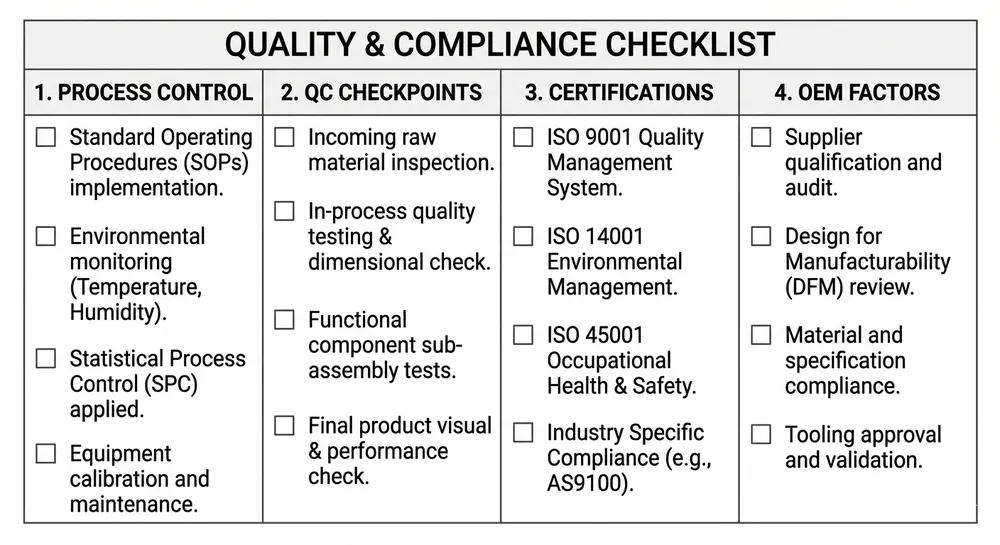
We run 50,000-cycle load testing as standard batch qualification on every production run — that's our floor, not our ceiling. Mechanisms going into commercial office programs get tested to 100,000 cycles. For buyers supplying into markets with specific certification requirements (BIFMA in North America, EN 1335 in Europe), we can provide the test documentation with shipment.
The sourcing risk here is buying mechanisms with a cycle life claim but no test report to back it. A supplier who quotes "100,000 cycles" without offering a test report is giving you a marketing number, not an engineering number. Ask for the report. If they can't produce it, the number isn't real.
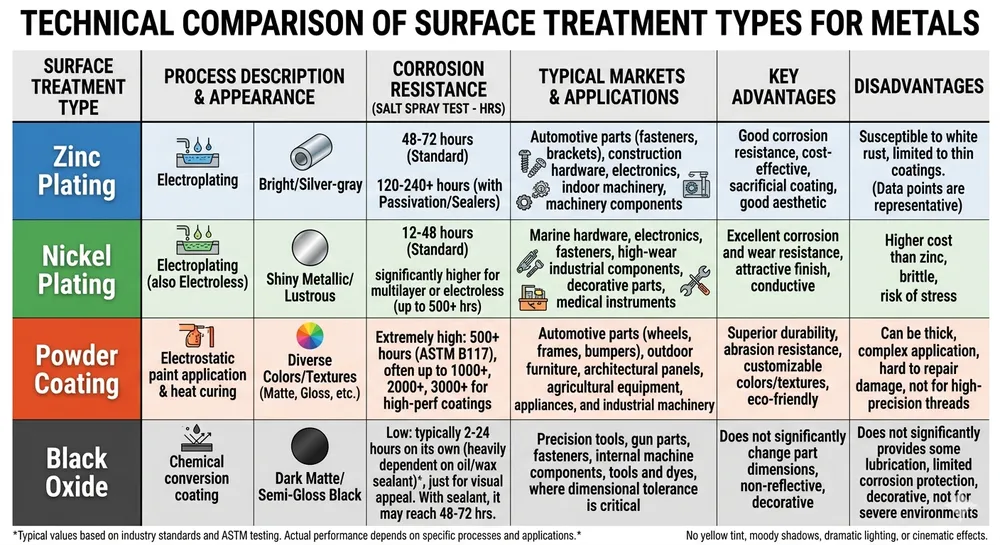
Surface treatment and corrosion resistance
Surface treatment affects both appearance and corrosion resistance — which matters differently depending on your export market.
| Treatment | Corrosion resistance | Typical application |
|---|---|---|
| Zinc plating | 72–120 hours salt spray | Standard indoor commercial use |
| Nickel plating | 200–300 hours salt spray | Premium finish, tight-tolerance components |
| Powder coating | 500+ hours salt spray | Coastal markets, high-humidity environments |
| Black oxide | Minimal | Aesthetic only, indoor use |
For buyers supplying into coastal markets — Southeast Asia, the Gulf, parts of Australia — powder coating on the mechanism is worth specifying. We learned this from a run of zinc-plated mechanisms that went to a Gulf distributor: the salt spray performance was fine by standard indoor specs, but the humidity and salt air in that market accelerated surface corrosion faster than the spec predicted. We moved those accounts to powder coat and the warranty claims stopped.
(The powder coat adds a small amount of thickness — typically 60–80μm — which can affect fit on tight-clearance assemblies. For mechanisms where the coating interfaces with a precision-fit component, we use nickel or zinc plating instead and specify the coating thickness in the drawing.)
—
How to Read a Swivel Mechanism Spec Sheet — and What's Missing from Most of Them
A spec sheet from a mechanism supplier should give you enough information to make a sourcing decision without a phone call. Most don't. Here's what a complete spec sheet includes versus what you typically get:
| Parameter | What a complete spec sheet shows | What most spec sheets show |
|---|---|---|
| Load rating | Static + dynamic, with test standard cited | Static only, no standard cited |
| Rotation range | Arc + torque variance across batch | "360°" with no tolerance |
| Cycle life | Cycles + load + test method | A number, no methodology |
| Mounting pattern | Hole layout drawing with dimensions | "Standard 4-hole" |
| Plate dimensions | L × W × H with tolerances | Overall dimensions only |
| Surface treatment | Treatment type + salt spray hours | "Chrome" or "black" |
| Material grade | Steel grade designation | "Steel" |
When you receive a spec sheet that's missing the right column, you have two options: ask for the missing data before ordering, or accept the sourcing risk. For a trial order of 500 units, the risk is manageable. For a 5,000-unit container, it's not.
The Swivel Chair Mechanism product page on our site lists the full spec parameters for our standard catalog range — static and dynamic load ratings, cycle life test results, mounting pattern drawings, and surface treatment options. That's the starting point for most RFQs we receive.
—
Specifying Correctly in Your RFQ: A Practical Checklist
The RFQ stage is where spec clarity pays off. A well-specified RFQ gets you an accurate quote, a realistic lead time, and a sample that matches what you actually need. An under-specified RFQ gets you a quote based on the supplier's assumptions — which may or may not match your application.
Here's what to include when you submit an RFQ for swivel chair mechanisms:
Application and market
- Target market (North America, Europe, Southeast Asia, etc.)
- End application (commercial office, home office, lounge, heavy-duty)
- Any certification requirements (BIFMA, EN 1335, other)
Load and performance
- Required static load rating (kg)
- Required dynamic load rating (kg) and cycle life (cycles)
- Rotation configuration (full 360° or limited arc — specify degrees if limited)
Dimensional compatibility
- Seat shell mounting pattern (hole layout and dimensions, or send a drawing)
- Gas lift column diameter (standard 50mm or specify)
- Any height or footprint constraints
Surface and finish
- Required surface treatment
- Target market humidity/corrosion environment
- Any color or finish requirements
Volume and logistics
- Order quantity (units)
- Target delivery port
- Packaging requirements (standard export carton or custom)
If you're not sure about some of these parameters — particularly the cycle life requirement for your target market — tell us the application and we'll recommend the appropriate spec. That's a faster path to an accurate quote than guessing and revising.
For Chair Mechanism sourcing across the full range — tilt mechanisms, synchro mechanisms, and swivel bases — the category page covers the product range and standard spec options.
—
Frequently Asked Questions
What load rating do I need for a commercial office chair mechanism?
For standard commercial office use, specify a minimum 120 kg static load rating with 100,000-cycle dynamic testing at that load. If your market includes users above 120 kg or the chairs will be in high-use environments (call centers, 24-hour operations), move to 150 kg static with reinforced plate construction. The material grade changes at that threshold — Q235 plate is sufficient to 120 kg; above that, Q345 or equivalent is the right call.
Does "360° rotation" mean the same thing across all suppliers?
No. The arc is the same, but the rotation feel — smoothness, consistency across a batch — varies significantly based on the dimensional quality of the swivel socket. Ask for the rotational torque variance spec across a production batch, not just the rotation arc. If a supplier can't give you that number, you're buying on faith.
How do I know if a cycle life claim is real?
Ask for the test report. A legitimate cycle life rating comes from a documented test: load applied, cycles completed, failure mode (or pass). The report should cite the test standard (BIFMA X5.1, EN 1335-3, or equivalent) and the load used during testing. A number without a report is a marketing claim.
What's the minimum order quantity for custom mounting patterns?
For OEM mechanisms with a non-standard mounting pattern, MOQ depends on tooling. We build tooling in-house, which keeps revision cycles short, but the tooling cost needs to amortize across the run. For most custom mounting patterns, the practical MOQ is 500–1,000 units. Send us your drawing and we'll give you the honest number.
Can I source mechanisms with CE and BIFMA certification from the same factory?
Yes, but confirm that the test reports cover both standards — they test different parameters. CE (EN 1335) is the European standard; BIFMA X5.1 is the North American standard. We hold CE certification and can provide BIFMA-compliant test documentation for buyers supplying into North American markets. Both sets of documentation ship with the order.
—
Putting the Specs Together Before You Order
The spec parameters covered here — load rating, rotation range, cycle life, mounting pattern, surface treatment — aren't independent checkboxes. They interact. A 150 kg load rating requires a specific material grade, which affects plate thickness, which affects mounting hole geometry, which affects compatibility with your seat shell. Getting one right while leaving another unspecified means the sample may pass your initial check and fail in the field.
The buyers who have the smoothest sourcing experience with us are the ones who come in with a clear application brief — target market, end use, volume, and any certification requirements — even if they don't know the exact spec numbers yet. We can translate an application brief into a mechanism spec. What we can't do is fix a misspecified order after production has started.
If you have a load rating requirement, a rotation spec, and a target application, submit an RFQ and we'll come back with a specific mechanism recommendation, full spec sheet, and factory-direct quote. If you're still working out the spec, send us what you have — we'll help you close the gaps before the order is placed.